Author: lungiletech

  • Traditional Intellectuals

    by Koketso Potsane

    Art has always been used to make statements about what is happening. In his article “Reciprocal Bases of National Culture and the Fight for Freedom,” Frantz Fanon argues that extreme ways of colonial domination always disrupts [in spectacular fashion] the cultural life of a conquered people. This is made possible by the laws/rules introduced by the occupying power. However; as colonial empires collapse the contradictions in the colonial system strengthen and maintain the peoples will to fight while promoting and giving support to national consciousness. This article is going to look at how Izithunywa Zohlanga (Messengers of the Nation) use indigenous repertoire and idioms to produce music and literature that speaks directly to the present in post-Apartheid South Africa while at the same time being custodians of our heritage through performances.

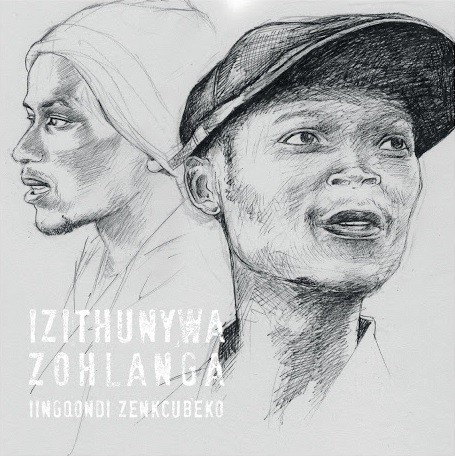
    Liyo and Pura are Izithunywa Zohlanga; a duo that comes out of the Eastern Cape, South Africa. The two grew up together and went to school together in Port St. Johns and East London. As kids they used to mime rappers like Snoop Doggy Dog, 2 Pac, Busta Rhymes and others during school functions. Around 1993, they started looping beats with cassette decks. After matric they both attended Cape Audio College in Cape Town.

    They then enrolled at The University of Fort Hare to study African Music and Literature.  These brought them a broader insight in linguistics/literary skills, traditional song/rhythm, and contextual/conceptual approach. They were the two of the five founding members of the Afro-fusion band Udaba (Matters), together with jazz musicians Indwe and Sakhile Moleshe, and historian/linguist Sibusiso Mnyanda where they were merging traditional instruments such as uHadi, uMqube, uMqanghi and iKatara with modern instruments fusing sounds of the past, the present and the future. During this period Udaba worked with well-seasoned musicians such as the veteran of Xhosa folklore Madosini, Lwanda Gogwana, Ayanda Sikade, Shane Cooper, Wakhile Xhalisa, Vuyo Khatsha, Texito Langa, and the legendary poet Kgafela oa Mogogodi.

    According to Fanon, in the beginning of the occupation the artist produces work [to be read] exclusively by the oppressor, whether with the intention of charming him or of denouncing him through ethnical or subjectivist means, as colonial empires collapse the artist takes on the habit of addressing his own people. Even though Izithunywa Zohlanga recites in Xhosa, they deal with universal concepts, whether they are political, social or economic. On another level, as Fanon continues, the oral traditions – stories and songs of the people – which were put away as set pieces now begin to change.

    “The storytellers who used to relate inert episodes now bring them alive and introduce into them modifications which are increasingly fundamental. There is a tendency to bring conflicts up to date and to modernise the kinds of struggle which the stories evoke (Fanon, 1959).”

    It is in this way that Izithunywa Zohlanga’s music takes on a Pan-African stance where through it they try to bring together Africans from different backgrounds. Their art might be called, what Fanon calls “the art of combat.” Their music stays relevant because they deal with everyday issues like substance abuse, violence against women and the struggle of students for equitable education. Izithunywa Zohlanga’s art is the art of combat because it assumes responsibility, and because it is the will to liberty expressed in terms of time and space.

    The experience that the duo gained from working with all those seasoned artists resulted in them engaging in a scholarly movement along with their contemporaries. This influence soon led to both individuals establishing themselves as independent artists as Liyo set himself on a journey as the musical director of the sensational uMthwakazi band, while Pura became the African prose master in his live project Funda uMyalezo (Learn the Message). Both these works led to these artists becoming activists, engaging in various skills development programs in townships and villages educating the youth in culture and music.

    Fanon also argues that the contact of the people with the new movement makes the artist come up with a new rhythm of life and to [forgotten muscular tensions, develops the imagination]. Every time the artist adds new styles to their work the artist relates a fresh episode to his public, which will result in the people asking new questions or even the old ones anew. The idiom used by the duo is mostly inspired by Xhosa literature more than street lingo. As Pura puts it, “[They] just did not want to dilute the pureness of the language.” They even collaborated with a Tswana Hip-Hop group called Retsamaya Legae (We Walk Our Homeland) from Pretoria, Gauteng, to suggest that this is not just a Xhosa movement but an African one.

    Storytelling according to the duo is a way of preserving culture. Their music tries to balance between oral tradition and literature. Similarly, the use of traditional instruments and sounds is an “attempt” to preserve heritage. Even though there is a restricted circulation of relevant information in post-apartheid South Africa, it is through live performances that they share their music with the public. They have also published an anthology called Umculo Buciko – the phrase – directly translates to oratory music, and even though they invented it specifically for their sound there have been other artists in the Eastern Cape who identify with it. It became a sub-genre of Hip-Hop similar to Motswako and Spaza. Their first album Iiqgondi Zencubeko (Traditional Intellectuals) shows that they have taken direction of not just being artists but also being teachers and custodians of culture.

    These show that as Fanon elaborates, as the new movement gives rise to a new rhythm of life, the existence of a new type of artist is revealed to the public. “The present is no longer turned in upon itself but spread out for all to see.” The artist once more takes charge of their imagination. They introduce new ideas and patterns into their work of art.

    Izithunywa Zohlanga not only use traditional repertoire and idioms to preserve heritage and be custodians of culture but produce art that makes critical statements about what is happening in the present. Their knowledge of Xhosa proverbs, metaphors, rhythms and the influence of black-centred ideologies influence their radical original style of music which makes them produce the “art of combat.”


    Reading List

    Bellio, Ellinore. ‘The Anti-Art of Kongofuturism.’ Land and Homeland.  Chimurenga Chronic, (April 2013): 38-39

    Fanon, Frantz. 1959. ‘Reciprocal Bases of National Culture and the Fight for Freedom.’  Botsotso, 17 (2016): 228-238.

    Hutchings, Shabaka. ‘The Way I See It, We Need New Myths.’ The Fiction of International Law. Chimurenga Chronic, (April 2016): 2.

    Ipadeola, Ayatande. ‘Poema: The Art of the Talking Drum.’ Land and Homeland. Chimurenga Chronic, (April 2013): 43.

    Sekyiamah, Nana Dakoa. ‘Gospel Christian Porn Rap.’ The Philantropic Complex. Chimurenga Chronic, (August 2013): 34-35.

  • Chronic Circulations Bibliography

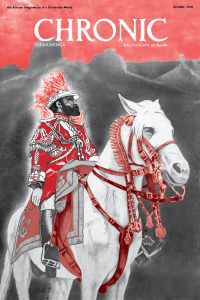
    The new addition of the Chronic asks: What is the African imagination of a borderless world? The African world has produced plenty of these and the ChronicOn Circulations And The African Imagination Of A Borderless World seeks to map and pay tribute to these existing works that articulates histories of circulation from an African perspective: from non-universal universalisms, to the right to opacity, refusing that which has been refused to you, and “keeping it moving” and more.

    It is thus largely a bibliographic project and the maps produced for this issue are based on a growing library of books, recordings, essays and stories by countless writers, thinkers and musicians around the world.

    The bibliography below represents a selection of the primary resources used to produce the maps and the issue. It is an part of an ever growing library that re-images our world beyond so-called progressive discourse on “freedom of movement” and “no borders” against the backdrop of deeply Western individualist thinking. Keep coming back for updates.


    ON CIRCULATIONS AND THE AFRICAN IMAGINATION OF A BORDERLESS WORLD

    Required reading:

    Le discours antillais, Édouard Glissant, 1981, Éditions du Seuil.

    The idea of a borderless world: Tanner Lectures on Human Values, Achille Mbembe, 28 March 2018, Yale University, https://www.youtube.com/watch?v=NKm6HPCSXDY.

    Additional reading:

    African Orature and Human Rights, Micere Mugo, 1991, Human People’s Rights Monograph Series, no. 13.

    African Philosophy as Expressed in the Concepts of Hospitality and Ubuntu, Julius Gathogo, Journal of Theology for Southern Africa, no. 130, pp. 39 53.

    A history of the upper guinea coast 1545-1800, 1970, Walter Rodney, Monthly Review Press

    Altered States, Anthony Kwame Appiah, 1991, Wilson Quarterly.

    Asante in the Nineteenth Century: The Structure and Evolution of a Political Order, Ivor Wilks, 1975, Cambridge University Press

    Beyond a Boundary, CLR James, Duke University Press Books; 1993.

    Black Atlantic: Modernity and Double-Consciousness, Paul Gilroy, 1993, Harvard University Press

    Charte du Manden, Wikipedia, 2018, https://fr.wikipedia.org/wiki/Charte_du_Manden

    Comment philosopher en islam ?, Souleymane Bachir Diagne, 2014, Philippe Rey.

    Containers, Carriers, Vehicles: Three Views of Mobility from Africa, Clapperton Chakanetsa Mavhunga et. al. 2016, Transfers vol. 8.

    Decentralization and territorial politics: the dilemma of constructing and managing identities in Uganda, Morris Adam Nsamba, 2013, Critical African Studies, vol. 5, no. 1.

    Decolonise: Open African Borders, Achille Mbembe 2017, Mail & Guardian.

    El Despertador Mexicano, Zapatista Army of National Liberation, 1993, http://archive.oah.org/special-issues/mexico/zapmanifest.html

    Éloges des frontières, Régis Debray, 2010, Gallimard.

    Europe’s Other Self, Stuart Hall, 1991, Marxism Today, vol. 35, no. 8.

    Frères migrants, Patrick Chamoiseau, 2017, Éditions du Seuil.

    Knowledge of Africa, Knowledge by Africans: Two Perspectives on African Studies, Paulin J. Hountondji, 2009, RCCS Annual Review.

    Les Migrants et nous: Comprendre Babel, Michel Agiers, 2016, CNRS Editions.

    Les miroirs vagabonds ou la décolonisation des savoirs (art, littérature, philosophie), Seloua Luste Boulbina, 2018, Les presses du réel.

    On the Postcolonial and the Universal ? , Souleymane Bachir Diagne, 2013, Rue Descartes, no 78.

    Philosophie de la relation, Edouard Glissant, 2009, Gallimard.

    Politiques de l’inimitié, Achille Mbembe, 2016, Éditions la Découverte

    Quand les murs tombent, Edouard Glissant and Patrick Chamoiseau, 2007, Galaade Éditions.

    Reading Ibn Khaldun in Kampala, Mahmood Mamdani, 2017, Journal of Historical Sociology, vol. 30, no. 1.

    Sortir de la grande nuit, Achille Mbembe, 2010, Éditions la Découverte

    Sovereignty, Territory and Authority: Boundary Maintenance in Contemporary Africa, Lee J.M. Seymour, 2013, Critical African Studies, vol. 5, no. 1.

    Rending the Nomad: Film and architecture reading Fulani, Ikem Stanley Okoye, 2010, Interventions, International Journal of Postcolonial Studies, vol. 6, no. 2.

    The African Frontier: The Reproduction of Traditional African Societies, edited by Igor Kopytoff, 1987, Midland Books.

    The Evolution of the Administrative Boundaries of. Ashanti, 1896-1951, R. B. Bening, , 1978, Journal ofAfrican Studies, vol. 2, pp. 123- 150.

    The Ink of the Scholar, Souleymane Bachir Diagne, 2017, Codesria.

    The Gadzingo: Towards a Karanga Expansion Matrix in 18th- and 19th-Century Southern Zimbabwe, Gerald Chikozho Mazarire, 2013, Critical African Studies, vol. 5, no. 1.

    The Odyssey of Human Rights, Ajume Wingo, 2010, Transition, No. 102, pp. 120-138

    The origin of others, Toni Morrison, 2017, Harvard University Press

    Audre Lorde’s Transnational Legacies, Stella Bolaki, Sabine Broeck, Sabine Bröck-Sallah, 2015, University of Massachusetts Press.

    The World The Text and the Critic, Edward Said, 1983, Harvard University Press.

    Tûba: An African Eschatology in Islam, E. Ross, 1996, PhD Thesis, University of Montréal.

    Une nouvelle region du monde, Edouard Glissant, 2006, Gallimard.

    What Do You Mean There Were No Tribes in Africa?: Thoughts on Boundaries: And Related Matters: In Precolonial Africa, Donald R. Wright, History in Africa, vol. 26, pp. 409-426


    THE BORDER IN THE EUROLIBERAL IMAGINATION

    Required reading:

    Borderland Europe – The challenge of migration, Balibar, Etienne, 2015, Open Democracy, https://www.opendemocracy.net/can-europe-make-it/etienne-balibar/borderland-europe-and-challenge-of-migration.

    Exodus, Paul Collier, 2013, Oxford University Press.

    Movement and the Ordering of Freedom, Hagar Kotef, 2015, Duke University Press.

    Why No Borders, B. Anderson et al, 2009, Refuge Journal, vol. 26, no. 2.

    The Rights of Others: Aliens, Residents, and Citizens, Seyla Benhabib, 2004, Cambridge University Press.

    Universal Declaration of Human Rights, United Nations, 1948, http://www.un.org/en/universal-declaration-human-rights/

    Zum ewigen Frieden, Immanuel Kant, 1795, F. Nicolovius.


    Additional reading:

    Atlas de migrants en Europe, Migreurop, 2017, Armand Colin.

    Barbed Wire: A political history, Olivier Razac, 2003, The New Press.

    Border as Method or the Multiplication of Labor, Sandro Mezzadra 2013, Duke University Press.

    Borderlands, 2016, Michel Agiers, Wiley.

    Borderwall as Architecture: A Manifesto for the U.S.-Mexico Boundary, Ronal Rael, 2017, University of California Press.

    Development Goals in an Era of Demographic Change, Worldbank, 2016, http://pubdocs.worldbank.org/en/31141444230135479/GMR-Over-and-Exec-Summary-English.pdf

    Globalization for Development: Trade, Finance, Aid, Migration, and Policy, Ian Goldin, Kenneth A. Reinert, 2007, Worldbank.

    Human Flow, Ai Weiwei, 2017, AC Films.

    La forme-camp. Pour une généalogie des lieux de transit et d’internement du présent, Federico Rahola, 2007, Cultures & Conflits vol. 70, pp. 31-50.

    Les refugies une bonne affaire, Nicolas Autheman, 2017, Le monde diplomatique.

    Open Borders: A Utopia?, Harald Bauder, translated by Sophie Didier, spatial justice, 2013, no. 5.

    Marcos Ramirez Erre: Border art ‘from this side’, Jo-Anne Berelowitz, 2006, Journal of Borderlands Studies, vol. 21, no. 2.

    Migration Borders Freedom, Harald Bauder, 2017, Routledge.

    Migrations sauvetage en mer et droits humains, Philippe Rekacewicz, 2009,  https://visionscarto.net/migrations-sauvetage-en-mer.

    Minoritarian Democracy: The Democratic Case for No Borders, James A. Chamberlain, 2017, Constellations vol. 24, no. 2.

    Passing Through: India’s Border Fence with Pakistan, Elizabeth Rush, 2012, Le monde diplomatique.

    Re-Imagining the Border Border Art as a Space of Critical Imagination and Creative Resistance, Giudice and Giubilaro, 2015, Geopolitics vol. 20, no. 1.

    The Age of the World’s Borders, PisseGuri82, 2018, https://moverdb.com/world-border-age/.

    The Border Art Workshop, Art for Social Change Toolkit Blog, 1984, https://artforsocialchangetoolkit.wordpress.com.

    Theory of the Border, Thomas Nail, 2016, Oxford University Press

    The Figure of the Migrant, Thomas Nail, 2016, Standford University Press.

    The Intermediary Class, Sam Allingham, 2018, The New Yorker.

    The Jean Monnet Bridge, Center for Political Beauty, 2015, http://www.politicalbeauty.com/rescue.html.

    The magna carta manifesto liberties and commons for all, Peter Linebaugh 2008, University of California Press.

    The Mediterranean’s deadly migrant routes, BBC, 2015, https://www.bbc.com/news/world-europe-32387224.

    The mobilities of ships and shipped mobilities,  Anyaa Anim-Addo, William Hasty and Kimberley Peters, 2014, Mobilities, vol. 9, no. 3.

    The Reconstruction of the Free World, Ulrike Guerot and Robert Menasse, 2016, OpenDemocracy https://www.opendemocracy.net/can-europe-make-it/ulrike-guerot-robert-menasse/europe-reconstruction-of-free-world

    Walled States, Waning Society, Wendy Brown, 2014, MIT Press.

    We Are Everywhere: The irresistible rise of global anti-capitalism, Notes from Nowhere, 2003, Verso.

    We Refugees, Giogrio Agamben, 1995, Symposium vol. 49, no. 2.

    Where on Earth Are You ?, Frances Stonor Saunders, 2016, London Review of Books. Vol. 38 No. 5.

    Why Immigration Controls Are Not Coercive, David Miller, 2009, Political Theory vol. 38, no. 1.

    THE UNHOLY TRINITY

    Required reading:

    Settler Colonialism: Then and Now, Mahmood Mamdani, 2015, Critical Inquiry vol. 41.

    Racial comparisons, relational racisms: some thoughts on method, David Theo Goldberg, 2009, Ethnic and Racial Studies, vol. 32.

    A Political Theology of Race: Articulating Racial Southafricanization, David Theo Goldberg, 2009, Cultural Studies, vol. 23, no. 4.

    Additional reading:

    Après le mur. Les répresentations israéliennes de la separation avec les Palestiniens, Cédric Parizot, 2009, Cultures & Conflict, pp. 53-72.

    Border / Skin, Lindsay Bremner, 2005, http://www.academia.edu/6089661/Border_Skin.

    Deutsche Integrationspolitik als koloniale Praxis, Kien Nghi Ha, 2009, transcript, pp. 137-150.

    Enduring territoriality: South African immigration control, Darshan Vigneswaran,  2008, Forced Migration Studies Programme, University of the Witwatersrand.

    In-secure identities: On the securitization of abnormality, Merav Amir and Hagar Kotef, 2018, Environment and Planning D: Society and Space, vol. 36, no. 2, pp. 236-254.

    Israel Closure Policy, Amira Hass, 2002, Journal of Palestine Studies, vol. 31, no. 3, pp. 5-20.

    Israel’s Holocaust and the Politics of Nationhood, Idith Zertal, 2010, Cambridge University Press

    Mapping Europe’s War on Immigration, Philippe Rekacewicz, 2013, Le monde diplomatique, https://mondediplo.com/outsidein/mapping-europe-s-war-on-immigration.

    The Architecture of Erasure, Saree Makdisi, 2010, Critical Inquiry, vol. 36, no. 3, pp. 519-559.

    The EU’s expulsion machine, Alain Maurice and Claire Rodier 2010, Le monde diplomatique, https://mondediplo.com/2010/06/12expulsions.

    The invention of the concentration camp. Cuba. Southern Africa and the Philippines 1896-1907, Jonathan Hyslop, 2011, South African Historical Journal vol. 63, no. 2.

    The refugees welcome culture, Joshua Kwesi Aikins and Daniel Bendix, 2015, Africasacountry, https://africasacountry.com/2015/11/resisting-welcome-and-welcoming-resistance.

    Walking through walls, Eyal Weizman, 2006, EIPCP, http://eipcp.net/transversal/0507/weizman/en.

    THE NEWSPAPER, THE NOVEL AND THE INVENTION OF THE NATION-STATE

    Imagined communities: reflections on the origin and spread of nationalism, Benedict Anderson, 1991, Verso.


    PANAFRICANISM VS. THE NATION-STATE I & II

    Africa Unite ! Une histoire du panafricanisme, Amzat Boukari-Yabar, 2017, Éditions la Découverte.

    Toward the Seventh PAC The Pan-African Congress Past, Present and Future By C.L. R. James, 1976, Ch’indaba.


    AFRO ASIAN MOVEMENT

    Required reading:

    Afro-Asian Movement: Ideology and Policy of the Third World, David Kimche, 1973, Israel Universities Press

    Lotus Magazine, Nida Ghouse, 2015, Chimurenga Chronic/Muzmin.

    The Pharaoh’s New Clothes, Sophia Azeb, 2015, Chimurenga Chronic/Muzmin.

    Colonial Architecture or Relatable Hinterlands? Locke, Nandy, Fanon and the Bandung Spirit, Robbie Shilliam, 2015, Constellations, vol. 23, no. 3.

    Additional reading:

    Afro-Asian Third-Worldism into Global South: The Case of Lotus Journal, Hala Halim, 2017, Global South Studies: A Collective Publication with The Global South.

    Making a World After Empire: The Bandung Movement and Its Political Afterlife, edited by Christopher Lee, 2007, Ohio University Press.

    Legacies of Bandung: Decolonisation and the Politics of Culture, Dipesh Chakrabarty, 2005, Economic and Political Weekly vol. 40, no. 46, pp. 4812– 4818.

    Postcolonialism: From Bandung to the Tricontinental, Robert Young, 2005, Historein no. 5, pp. 11– 21.

    The Darker Nations: A People’s History of the Third World, Vijay Prashad, 2007, The New Press.

    The Midnight Ride of Kwame Nkrumah and Other Fables of Bandung (Ban-Doong), Robert Vitalis, 2013, Humanity: An International Journal of Human Rights, Humanitarianism, and Development vol. 4, no. 2, pp. 261–288.


    NEGRITUDE VS AFRORADICALISM

    Africa Unite ! Une histoire du panafricanisme, Amzat Boukari-Yabar, 2017, Éditions la Découverte.


    MOVEMENT OF JAH PEOPLE

    Freedom as Marronage, Neil Roberts, 2015, University of Chicago Press.

    Africa Unite ! Une histoire du panafricanisme, Amzat Boukari-Yabar, 2017, Éditions la Découverte.

    Fugitif, où cours-tu ?, Dénètem Touam Bona, 2016, PUF.

    Maroon Societies: Rebel Slave Communities in the Americas, Richard Price, 1979, Johns Hopkins University Press.


    NO PASS, BUT NINE PASSPORTS

    Required reading:

    Makeba: My Story, Miriam Makeba with James Hall, 1988, Bloomsbury.

    Miriam Makeba in Guinea – Deterritorializing History through Music, Yair Hashachar, 2015, MA thesis, The Hebrew University of Jerusalem.

    Playing the Backbeat in Conakry: Miriam Makeba and the Cultural Politics of Sékou Touré’s Guinea, 1968–1986, Yair Haschachar, 2017, Social Dynamics vol. 43, no. 2, pp. 259-273.

    The Miriam Makeba Story: Miriam Makeba in Conversation with Nomsa Mwamuka, Miriam Makeba and Nomsa Mwamuka, 2004, STE Publishers.

    Miriam’s Place: South African jazz, conviviality and exile, Louise Bethlehem, Social Dynamics, 2017, vol. 43, no. 2, pp. 243-258.

    Additional reading:

    Liberated Threads: Black Women, Style, and the Global Politics of Soul, 2017, Tanisha C. Ford, The University of North Carolina Press.

    Miriam Makeba: Fidel Castro es una de mis estrellas, Cubaencuentro, 2005, http://arch1.cubaencuentro.com/cultura/noticias/20051006/11d15e783a3681722b1599b7ca1ada24.html.

    Miriam Makeba, l’exilée qui devint Mama Africa, Natou Pedro Sakombi, 2016, Reines & Héroïnes d’Afrique blog, https://reinesheroinesdafrique.wordpress.com/2016/03/04/miriam-makeba-lexilee-qui-devint-mama-africa/.

    Miriam Makeba: Mama Africa, Gamal Nkrumah, Al-Ahram Weekly Online, 2001, http://weekly.ahram.org.eg/Archive/2001/558/profile.htm.

    Miriam Makeba: une vie au service d’un art engagé, Michaël Mouity-Nzamba, Bulletin de l’Institut Pierre Renouvin, 2014/2, no. 40, pp. 111-125.

    Nina Simone in Liberia, Katherina Grace Thomas, 2017, Guernica Magazine, https://www.guernicamag.com/nina-simone-in-liberia/.

    Obituary: African Icon: Miriam, Thelma Ravell-Pinto and Rayner Ravell, 2008, Journal of the African Literature Association, vol. 2, no. 2, pp. 274-281.

    Ready for Revolution: The Life and Struggles of Stokely Carmichael (Kwame Ture). Stokeley Carmichael with E. M. Thelwell, 2003, Scribner.

    The Cultural Revolution, Artistic Creativity, and Freedom of Expression in Guinea, Lansine Kaba, The Journal of Modern African Studies, 1976, vol. 14, no. 2, pp. 201-218.

    The Voice of (Which?) Africa: Miriam Makeba in America, April Sizemore-Barber, 2012, Safundi: The Journal of South African and American Studies vol. 13, no. 3–4, pp. 251–276.


    WHEREVER I’VE GONE I’VE GONE VOLUNTARILY

    Wherever I’ve Gone, I’ve Gone Voluntarily: Ayi Kwei Armah’s Radical Pan-African Itinerary, Jonathan B. Fenderson, 2008, The Black Scholar, Vol. 37, No. 4, pp. 50-60.

    The Healers, Ayi Kwei Armah, 2000, Per Ankh.

    Osiris Rising: A Novel of Africa Past, Present and Future, Ayi Kwei Armah, 1995, Per Ankh.

    Two Thousand Seasons, Ayi Kwei Armah, 1973, Heinemann.

    Why Are We So Blest?, Ayi Kwei Armah, 1972, Doubleday

    The Beautyful Ones Are Not Yet Born, Ayi Kwei Armah, 1968, Heinemann.

    One Writer’s Education, Ayi Kwei Armah, 1985, West Africa, pp. 1752-1753.

    The Eloquence of Scribes: A Memoir on the Source and Resources of African Literature, Ayi Kwei Armah, 2006, Per Ankh.

    Our awakening. An Evening with Ayi Kwei Armah: Lecture at Berkeley University (transcript excerpt), 1990, Ayi Kwei Armah, http://www.africaspeaks.com/reasoning/index.php?topic=5904.0;wap2.

    New Insights from Ayi Kwei Armah: Conversation with Ayi Kwei Armah and Ayesha Harruna Attah, 2016, https://www.ghanawebsolutions.com/videos.php?v=knCGdYGJWXs.

    Ayi Kwei Armah Radical Iconoclast: Pitting Imaginary Worlds Against the Actual, Ode Ogede, 2000, Ohio University Press.


    DISLOCATIONS IN THE CONGOLESE WORLD OF SOUNDS

    Required reading:

    JB Mpiana, Wikipedia, 2018, https://fr.wikipedia.org/wiki/JB_Mpiana.

    Hervé Gola Bataringe alias Ferré chair de poule, Univers Rumba Congolaise blog, 2012, https://www.universrumbacongolaise.com/artistes/ferre-chair-de-poule/?cn-reloaded=1.

    L’histoire de la separation de Wenge Musica BCBG 4X4, Congo Musique blog, 2010,  https://congo-musique.skyrock.com/2891184757-L-HISTOIRE-DE-LA-SEPARATION-DE-WENGE-MUSICA-BCBG-4X4.html.

    Rumba Rules: The Politics of Dance Music in Mobutu’s Zaire, Bob. W. White, 2008, Duke University Press.

    The African Frontier: The Reproduction of Traditional African Societies, edited by Igor Kopytoff, 1987, Midland Books.

    Wenge Musica, Wikipedia, 2018, https://fr.wikipedia.org/wiki/Wenge_Musica.

    Wenge Musica Maison Mère, Wikipedia, 2018, https://fr.wikipedia.org/wiki/Wenge_Musica_Maison_Mère.

    Werrason, Wikipedia, 2018, https://fr.wikipedia.org/wiki/Werrason.

    Additional reading:

    Happy Are Those Who Sing And Dance: Mobutu, Franco, And The Struggle For Zairian Identity,Carter Grice, 2011

    Made in Congo: Rumba Lingala and the Revolution in Nationhood, Jesse Samba Samuel Wheeler, 1999, University of Wisconsin—Madison.

    Modernity’s Trickster: “Dipping” and “Throwing” in Congolese Popular Dance Music, Bob W. White, 1999, African Literatures vol. 30, no. 4.

    Rumba on the River: A History of the Popular Music of the Two Congos, Gary Stewart, 2003, Verso.

    Terre de la chanson: La musique zaïroise hier et aujourd’hui, Manda Tchebwa, 1996, De Boeck Supérieur.

    The Genesis of Urhan Music in Zaire, Kazadi wa Mukuna, 1992, African Music vol. 7, no. 2.

    The Political Economy of Migration and Reputation in Kinshasa, Joseph Trapido, Africa: The Journal of the International African Institute, vol. 81 no. 2, 2011.

    The value of Africa’s aesthetics, Achille Mbembe, On the Postcolony, 2015, WITS Press.

    Variations on the Beautiful in the Congolese World of Sounds, Achille Mbembe, 2009, Chimurenganyana Series 1.

    JAZZ AND THE WHITE CRITIC

    Livre culte, livre maudit: Histoire du Devoir de violence de Yambo Ouologuem, Jean-Pierre Orban, 2018, Continents manuscrits.

    Yambo Ouologuem: On Violence, Truth and Black History, interviewed by Linda Kuehl, 1971, ChickenBones: A Journal for Literary & Artistic African-American Themes, http://www.nathanielturner.com/yamboouologuem.htm

    Yambo Ouologuem: Postcolonial Writer, Anti-Wahabist Militant, 2015, Chimurenga Chronic.

    In Search of Yambo Ouologouem, Christopher Wise, 2012, Chimurenganyana Series 2.


    LE TOUT MONDE

    Sartorius: Le roman des Batoutos, Édouard Glissant, 1999, Gallimard.

    Ormerod, Édouard Glissant, 2003, Gallimard.

    Tout-Monde, Édouard Glissant, 1993, Gallimard.

    La Lézarde, Édouard Glissant, 1958, Éditions du Seuil.

    Le quatrième siècle, Édouard Glissant, 1964, Éditions du Seuil.

    La Case du commandeur, Édouard Glissant, 1981, Éditions du Seuil.

    Mahagony, Édouard Glissant, 1987, Éditions du Seuil.


     This bibliography is for the new issue of the Chronic, On Circulations And The African Imagination Of A Borderless World, which maps the African imagination of a borderless world: non-universal universalisms, the right to opacity, refusing that which has been refused to you, and “keeping it moving”.


    To purchase in print or as a PDF head to our online shop, or get copies from your nearest dealer.


  • Dislocations in the Congolese World of Sound

    “Dislocation” is how Congolese rumba historians describe the incessant splinterings that are part of the story of every major band – in a music system where the “first to leave” holds the place of pride.

    Between 1997 and 2008 the group Wenge Musica lived through 18 dislocations – almost twice a year, starting with the epic rivalry between JB Mpiana and Werasson. Many of these ran parallel to the great war in Congo – another major site of dislocations.

    In the new Chronic, On Circulations and the African Imagination of a Borderless World, we map Wenge Musica BCBG family tree.

    To purchase a copies of this issue in print or as a PDF head to our online shop, or get copies from your nearest dealer.

    Congolese World of Sound from the archive:

    For the Pan African Space Station (PASS), Binetou Sylla — DJ, producer and Syllart label-boss — curated a series of shows focused on Congolese rumba and its offshoots. This episode includes music from Nico, Franco, and Tabu Ley. Recorded for PASS in Paris at the exhibition Beauté Congo – 1926-2015 – Congo Kitoko, Fondation Cartier.

    For more music visit Pan African Space Station (PASS)


    Then Achille Mbembe explores the Beautiful in the Congolese World of Sounds and tracks how the languid melodies characteristic of “classic” Congolese rumba (1950s-1970s) gave way to a new sound, a music laced with emotions ever in conflict, where the theatrical and the oneiric are superimposed on one another across a savage ocean of sounds, screams and noise – the sound of Koffi Olomide, Quartier Latin and Wenge Musica.

    Read online or order it in print as a Chimurenganyana from our online shop.


    Also dancer and choreographer Faustin Linyekula sets movement to a soundtrack of ndombolo, a music whose driving rhythms and sheer physicality offers the possibility for liberation from war and oppression, but simultaneously risks perpetuating the very violence and subjugation it seeks to transcend. ““The most important thing is not the aesthetic object. Art is not important. The most important thing is to believe in something in a context where it’s impossible to believe in anything. The work is thus an act of faith, says Linyekula. “So the form emerges. It’s music but it’s music that only makes sense when it has a physical impact. So we will turn up the volume. It has to be loud so we’ll stop hearing all the noise – NGOs, politicians, propaganda, statistics. So I can hear the sound of my body and then the sound will get the bodies to move.”

    Read it online or dig deeper with Chimurenga 16: The Chimurenga Chronic, available here in print or PDF.


    Tracing further movements and disolations across borders, Ranga Mberi travels back in musical time to the 1980s and 1990s, the era of sungura music. Dubbed the “authentic sound of Zimbabwe”, sungura weaved together Congolese rumba with Zimbabwean jiti and Tanzanian kanindo.

    Real it online or order the Chronic, “The Invention of Zimbabwe”, which writes Zimbabwe beyond white fears and the Africa-South conundrum – available in print or as a PDF from our online shop


  • TO REFUSE THAT WHICH HAS BEEN REFUSED TO YOU

    Fred Moten and Saidiya Hartman sit down to talk about the temporal and traditional in the age of refusal – of movement, of citizenship. They offer up a different way of thinking, a pathway to another understanding of community as well as the possibility of harnessing fugitivity as a creative empowering strategy*.

    Saidiya Hartman: One of the places I think about the outside is in this constitutive paradox. Frederick Douglass talks about the thought in deed or the thought in song and a philosophy of abolition that’s made inside the circle of slavery. He says, “one is only able to give an account of it from the outside.” One way of thinking about this idea is in temporal relations, which I think is wrong because then the outside comes after the inside. Rather, I think the tradition is to produce a thought of the outside while in the inside. Yes, the enclosure is brutal… but the practice is always about finding a way to produce an outside within that space. It seems to me that a history of black thought (one that’s not the thought of canonical thinkers) the thought of most folks is really devoted to this labour of trying to produce an outside, trying to create an opening, which is often only discernible belatedly and it’s discernible as it becomes marked as crime or as it’s subject to a new form of enclosure that is the response to a certain kind of making/happening. Given the kind of unceasing onslaught of militarised violence directed against a civilian population, I’ve been thinking a lot about the space of the hold and what happens there. For me, part of the paradox is that the ordinary is constituted by stuff that is so terrible and impossible to bear and yet in that context, people make things happen, they continue to act/ produce. I want to keep those two things in tension; both the terror and the opening.

    Fred Moten: It reminds me of an essay by Foucault on Maurice Blanchot called The Thought of the Outside. One way to think about it is the reason why we feel it necessary to constantly, I don’t want to say go back to the hold, but the reason we feel it necessary to renew our consciousness of being in the hold, so to speak, is because maybe there’s a way in which the thought of the outside can only occur from the inside. On one hand we speak in reverence of a tradition of the thought of the outside or the tradition of those able to be in two places at one time. I always thought that was the real importance and beauty of Harriet Ann Jacobs’ Incidents in the Life of a Slave, which is about constantly trying to figure out how to be in two places at the same time, under absolute duress, often in both places. But there is a sense in which the constant renewal of the terms and conditions of that inside/outside opposition becomes debilitating in many ways in and of themselves.
    It reminds me, I’m from small town in Arkansas called Kingswood that only has 300 people. My aunts lived in another town that wasn’t really a town, called New Edinburg, which the people in Kingswood would call “the country”. Then there were people who lived so deep in the woods that we referred to them as “living out from” New Edinburg. So, I’ve been trying to think of living out from the outside, or out, so to speak, of that inside/outside opposition. It’s hard to not think of yourself in some kind of infinity loop or some kind of Yayoi Kusama infinity room, but when I think of the outdoors, the black outside, I think of it as this thing which is to be out from the outside. Or what are the conditions that would make such a thought possible, and also necessary, so a meta out; an ec ec; extra ecclesiastical.
    The thing that was in my mind for the last few weeks before coming back here, was that when I lived here before, as a kid, I could just always hear somebody running. I just felt like being in those instances of being out in the woods. That for me is where I was closest to the runaway. So, I can’t separate the outside from this constant necessity and activity of running away, of flight. This means that the outside is always bringing those constraints with it. And it’s impossible not to think about those things now. It’s always impossible to not think about those things, but for some reason it just seems like there are more people getting shot these days. It’s not actually true, but it just feels like it is… so…

    SH: One of things I thought was interesting from this “out-from”, even in this space what you’re already countering is that threat of enclosure/captivity. When you describe the “out-from”, there is a lovely book on marronage and it talks about petit marronage and marronage on the border, people who were close enough to the plantation to still be caught, who found a way to live in the trees but couldn’t leave any marks of human habitation. To me that’s a kind of an out-from. So, you escaped a certain kind of enclosure but that threat… it’s a certain dance… you’ve made this other mode of dwelling often inside the trunk of trees but you’re not in a relationship with the land via farming, the land isn’t displaying any signs of cultivation. What I wrestle with is the threat, the terror, the violence of enclosure and the vulnerability, the precarity of these makings. And we continue to make and create because that’s all we can do. There’s a kind of opening but there’s the structural container—the forces that are making living hard, impossible. And that those define so many of the circumstances in which these experiments and living unfold.

    FM: Somehow, I haven’t been able to make myself clear when it comes to certain things but I feel like it’s probably not my fault. I don’t know that it’s possible to be clear when it comes to these kinds of things, but let’s say… and I get scared about saying certain kinds of stuff because I feel like sometimes it could seem really callous and I don’t mean… I don’t want to seem that way because it’s not that I don’t feel, or that I don’t care. But let’s talk about it in terms of what it means to live in a way that would not reveal, not show, no signs of human habitation. Obviously there’s a field, a space, a constraint, a container, a bounded-space because every time you were saying unbounded, I was thinking, is that right? Noam Chomsky used to make this really interesting distinction –and I don’t think I really fully understood it – between that which is bounded but infinite, and that which is unbounded but finite. So, if it’s unbounded, it’s still finite and there’s a quite specific and often quite brutal finitude that structures whatever is going on within the general; if we can speak of what it is to be within the general framework of the unbounded… there’s never… I mean, the whole point about escape is that it’s an activity. It’s not an achievement. You don’t ever get escaped. Like, “I escaped!” No! And what that means is that what you’re escaping from is always after you. It’s always on you.
    What’s interesting to me – but its hard to think or talk about – is that we can recognize that absolute horror, the unspeakable incalculable terror and horror that accompanies the necessity of not leaving a trace of human inhabitation. And then there’s the whole question of, what would a life be that wasn’t interested in leaving a trace of human habitation? So fuck the human, human-inhabitation!
    I think of a phrase I often use – and I always think of it in relation to Fannie Lou Hamer, because it’s just me giving a theoretical spin on a formulation she made in practice: to refuse that which has been refused to you. And that’s what I’m interested in. And that doesn’t mean that what’s at stake is some kind of blind, happy, celebratory attitude toward all the beautiful stuff that we’ve made under constraint. I love all the beautiful stuff we’ve made under constraint but I’m pretty sure I would love all the beautiful stuff we’d make out from under constraint better. But there’s no way to get to that, except through this. We can’t go around this. We gotta fight through this. But, by the same token, anybody who thinks they can come even close to understanding how terrible the terror has been without understanding how beautiful the beauty has been against the grain of that terror, is wrong. There is no calculus of the terror that can make a proper calculation without reference to that which resists it. It’s just not possible. So this is the key thing to me.

    SH: I agree. When I think about these forms of living like petit marronage and how they come to an end and not even an absolute end because new practices emerge and there have always been an endless number of beautiful models of living otherwise. But that encounter: defeat and then we must reemerge again. So it’s not like you’re insufficiently accounting for the terror but I think that maybe we’re at this kind of shift. Like my own thinking right now is that we just have to be involved in that unceasing labour, producing these new experiments in living even as defeat continues to be the outcome… but we’re not stopped by that defeat. To escape isn’t finite. And I understand my “now” always in relationship to all these other “nows”. And often what has met those kind of beautiful experiments is certain forms of defeat, by the state, by the police, by reforming agents. It doesn’t mean that they kill or quash or can stop or snuff out that process but that’s also part of the field too.

    FM: I remember when you and Frank B Wilderson had that interview on “The Position of the Unthought” and you were messing with Fredric Jameson. There’s a romanticism that goes with detachment around this notion of the narrative of defeat, which he thinks specifically in relation to the league of revolutionary black workers… and it’s an insufficient account, it’s problematic. Part of the problem is what if it turns out that the kinds of terror, the particular kind of history that we’re trying to work through – talking about you as historical figure and me as profoundly ahistorical figure. It’s like, it’s not even something you can really talk about within a calculus of victory and defeat.
    Defeat is a word that seems applicable in many ways. And then you know there’s a whole specific black Christian discourse on victory that one wants to appeal to every once in a while… but it just might be that part of the problem is that the concepts we have been given in order to try and think and talk about this stuff we try and talk about, just don’t work. They’re inadequate, inoperative. And it might even be the case that the concept itself is an inadequate mental construct or that conceptualism itself is an inadequate intellectual disposition. It’s like we’re working on some other kind of stuff. I feel this reading your work all the time. You’re saying these things, using a given language but I know you’re talking about something else, in some other language. And so you have to work through that, it’s a difficult thing and I’m gonna just keep going. And I see black studies now as reaching a kind of crisis in a certain way; we just can’t keep going on like this. The conceptual apparatuses at our disposal are inadequate. And we’re just kind of spinning our wheels in a lot of ways, pushing up against the same hard rock so to speak. And it doesn’t mean that what’s needed is a new kind of theoretical disposition. It’s really a new set of kind of moral and ethical dispositions about how we treat one another and how we talk to one another. And it goes against the grain of any kind of a sense of somebody being able to achieve an adequate theoretical perspective on things by themselves. It’s a great relief to realise that I don’t have to do it by myself anyway. So whatever is inadequate about what I’m doing; luckily you’re doing something. It’s just not a one-person job.

    SH: I agree with you, we could say that’s an inadequacy or incommensurability between an available critical vocab and that which we’re trying to describe. You might think about this with W. E. B. Du Bois and the general strike. What he’s trying to describe is so vast and this is like okay, maybe if I call it this, it can bring some stuff into the view about how this is a politics of refusal against capitalism and the conditions of work, even as it is so much more than that. So, I agree with you about that inadequacy. I feel like I’m involved in a much more humble labour. I think I’m trying to describe belatedly, the things people have fought and have done and I’m just attending to them. So it’s this labour of regard, it is tripped up or struggling with how to illuminate that and it’s not that it isn’t a resource we work with and in some way know, but it’s an intimate labour in regard to what others have done and have thought, so, I’m a describer. But Fred, I don’t know if you want to talk about the poetry, your writing practice, which is so rich and varied and multiple…

    FM: I got to the point where, I mean, there’s so much overlap between the two things and I’ve never felt embarrassed about being interested in theory. I never was all that invested in being called a theoretician either. I was just somebody who was interested in theory and in that kind of general sense of people seeing, thinking about stuff and maybe certain movements of abstraction from what one sees and feels. I was always happy to be interested in doing that kind of stuff and I was also always happy to be interested in poetry and I never thought of these two things as being so utterly separate. The older I get, the more impossible it is to keep them separate but I do think, they both constitute, in the end, two different forms of description but it’s the same work.
    One way to think about it is people have different approaches to things, and a lot of it is just kind of temperament. The whole time I’m thinking of that classic old time song, “Keep on the Sunny Side”. I love that song and the way I do my work is I’m always looking at the sunny side. The peculiar nature of the sunny side in regard to black social lives is that it’s dark, but I’m still looking for the sunny side. But I know there are other people who don’t need to look for the sunny side. They’re more like midnight folks or 3am folks. Like Bobby “Blue” Bland, where every blues song happens at three in the morning? My mom used to say her arthritis always hurts most at 3am. Luckily, everybody doesn’t have to do the same thing. And what sad ethical condition are we in when it seems like everybody has to do the same thing? Why, now, does everybody have to do the same thing? All this writing, the state of this or that discipline, all carry an unspoken assumption that all are doing the same thing and everybody not doing the thing that I’m saying, is wrong. No! That’s just stupid, ridiculous. So there’s a bunch of different ways, attitudes, dispositions that are necessary to try to provide something that would approach an adequate description of who, what we are and who, what we might be.

    SH: I’ll say two things, and it’s a kind of a gross simplification, but in certain liberal storeographies of slavery it ends with a great legal act of emancipation. And writing scenes and writing my dissertation, one was about the non-event of emancipation because of the way in which these emergent modalities of servitude took place within a discourse of freedom, rights, liberty. I guess for me there was something more rotten at the core, which is about the imposition of a certain regime of the subject that was so fundamentally defined by property, and that being as good as it gets. So, I think it was both the impossibility of the achievement of those things that define a kind of liberal citizen subject in the West, the free being excluded from that. But then what are the kind of constituents of that subject to begin with and is that something that one wants to sign onto anyway? So many of the articulations of freedom, so much of the kind of practices of the ex-slave or the freed, articulated kind of another imagination of freedom altogether. So there’s the imposition of a certain regime of the subject and a certain conception of the domestic is crucial to the production of that subject.

    FM: I feel this general sense of having come to an impasse in a certain kind of way is interesting. It depends on how you think about it. So, let’s say that within a field that is bounded on the one hand by incompatible predications of the free, and on the other hand the burdened individuation (to use Saidiya’s terms). That within this structure that is bounded so to speak by those terms, there’s only so much you can do theoretically but that doesn’t mean that you stop trying to come up with things. Because the other notion of predication that has been in the back of my mind the last couple months is this predication that Nate Mackey had as he talks about predications “rickety spin”. I guess I’ve just begun to think what one might be able to do against the grain; of an incompatibility of a set of imposed predications that is continually spinning out, in however rickety, raggedy way, an endless series of predications.
    There was a certain moment in which the critique of authenticity, let’s say in black studies or whatever, became so puritanical, that any sentence of the type: “blackness is x”, was almost against the law, against the rules of the people and somebody would come get you… Touré or somebody. But, I’m interested in something like an endless proliferation of sentences of the type: blackness is x. Recognizing that those sentences might come from anywhere and might be animated by any number of possible motivations. But that necessity of predication, which could even be said to take the form of a certain kind of a meditative, worshipful kind of form, that’s important. And I think it’s one of those things in terms of describing what people have felt and what they’ve done. That’s one of the things that people have done.
    By the same token, there is this other slightly parallel track to predication, which may be just naming or nominalisation of these things as kind of connected but not exactly the same thing. And these are important cultural, aesthetic and intellectual activities that are crucial to anything; like what one might call a kind of… whatever you want to call it: A resistance. Fugitivity. War. Whatever. These are important activities to be engaged in because then it gives us a chance to think and talk. It gives us a chance to be together, as we meditate with one another on these questions. Hopefully with some friends, food, wine, kids running around. This is totally important. And from my perspective, these are activities that must be done, to use the old Cornel West phrase, “outside of the normative gaze of the white man”. It’s just that at a certain point, you can’t be worried all the time about what he says or thinks. For some reason I think this is particularly difficult for academics because we are addicted to being graded and they do the grading, or let’s just say the degrading.
    What I’m trying to say is that sense of… well, is this the right term? That’s a debilitating question but is this a term that we can start… that can get us talking about something? Is this a term that can help structure a certain kind of fellowship amongst us? That’s a different kind of question.

    * This is the edited transcript of a conversation that took place in 2016, part of a series titled “Black Outdoors: Humanities Futures After Property and Possession”.


     This and other stories and maps are available in the new issue of the Chronic, On Circulations And The African Imagination Of A Borderless World, which maps the African imagination of a borderless world: non-universal universalisms, the right to opacity, refusing that which has been refused to you, and “keeping it moving”.


    To purchase in print or as a PDF head to our online shop, or get copies from your nearest dealer.


    [hr]


  • They Won’t Go When I Go

    A Manifesto/ Mediation on State of Black Archives in America and throughout the Diaspora

    by Harmony Holiday 

    The ashes a black mother scattered into the lap of a seemingly indifferent police chief, her daughter’s remains in ash and shackle, the ashes of her daughter who had been killed in jail either by neglect or force, whose death was falsely recorded as another suicide in the holds, those are our archives. Both the video recording that captures the black ashes scattering into a white man’s lap, and the mother’s ritual, her piercing curse-on-him glance into his smug visage as she unleashes those tiny chimes he cannot jitter or equivocate off no matter how many laws he passes to defend his sickness, or lies he inks on dead trees, or phony official records they keep to contradict true stories. We keep a record of both the ritual and its transfiguration into object or commodity or reproduction on our tongues’ slow limbo between these broken lands. We understand that we are caught between two opposing tribes formed from the ark or archive, up— one in with the energy of a spirit-driven self-perpetuating fractal, the other a rusty arrow that hopes to block out the sun and infects everything on its path, draws blood to sustain itself.

    A clash of methods is festering, one wherein western sercretaryism (like syncretism but without the magic) and preemptive snitch culture (mis-telling the histories of the black, brown and innocent who have been muted by state power before the truth comes out), attempts to undermine the ancient technology of oratory, storytelling, collective memory, epigenetics, the ankh, knowing what we know. Because brown bodies must learn to care less about being right in the eyes of a penal code built on their criminalization, than about feeling right while carving out a life under this system, even if that means waging open spiritual attack on upholders of said system in their place of worship and terror, the courtroom, as that fearless mother did, we are willing to weaponize our archives and disappear them depending on what our spirits demand, what soothes our souls and that of the collective.

    In this way, the throbbing void where Lee Perry’s Black Ark Studios once flourished as a haven for dub music and invention in Kingston, Jamaica, before he burned it to the ground to lift the curse of sycophants and phantoms, that void is our archives. The space he cleared and malicious intent he banished with that deliberate fire, became the improvised catalog of the music and lifestyle invented there, now a resounding radio silence. As those who saw the space as a trend, flop house, or museum-to-be, sigh in grief at its incineration, Lee Perry himself gasps at them in ritual annoyance and does his victory spin, reminding everyone that his creative energy is no one’s prop.

    The Dogon Tribe in Mali, West Africa, a group of souls who descend from a distant stellar force in the universe called Sirius B, who know this to be true and can explain their origins in the cosmos with an accuracy that alarms and disarms Western Scientists because it is too advanced for the West’s neurotic linear logic, The Dogons’ lucid and unwavering knowing that blackness is a sacred technology, is our archives, the blueprint for the ark our memories of the future builds. We understand that to be ancient or from before is to be the future, and that we haven’t caught up with ourselves here, and can understand colonialism in terms of our own generosity of spirit and awareness that we carry urgent messages in our DNA and long to distribute them and help this planet remember its true role in the order and chaos of things.

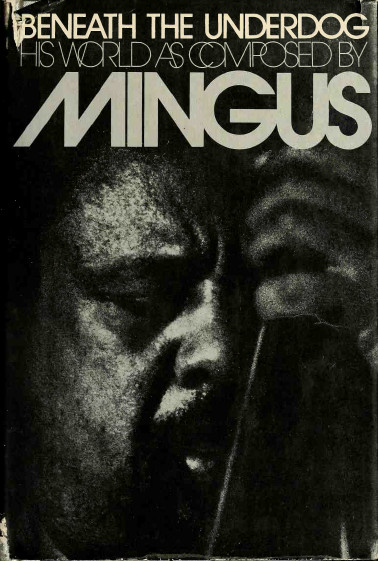
    In the Library of Congress, the only existing copy of the second volume of jazz bassist Charles Mingus’ autobiography, Beneath the Underdog, rests in quiet staccato with a gun-shaped space cut out of it, for this is where he hid his piece. The gun cubby and all of the missing notes tell as much of his story as an uninterrupted manuscript would. That empty space where an automatic weapon might have been is our archives, the loot on our ark that we abandon if it starts to weigh us down, because it was acting as a musical instrument anyways, improvising with the surrounding space to create an object only the black spirit can decode.

    The thousands of pages of notes the FBI takes on the mundane activities of black writers and cultural workers, from describing the clothing we wear to the slightest shift of tone in our voice during public speeches or private conversations, to who we hugged hello, to who we walked inside with and closed the door until the next morning, that state surveillance is our archives, the data they try to crunch and manipulate to compensate for a magnetism native to blackness that they will never understand, and cannot conquer.

    The ongoing project of piecing together my own father’s illusive history as a singer, recording artist, sharecropper, ninja, black cowboy, who was never properly taught to read or write, teaches me again and again to examine what was kept hidden or remote as meticulously as I do the obvious landmarks and trapdoors of a past. We are forced to do so much in code that sometimes that what we have left in us to perform and share openly is armor that grants us deeper access to our private selves, satiates the spectator’s curiosity, nudges the hounds off our backs. The recordings I find of my dad at home sketching ideas as he let the tape roll are often more beautiful and powerful than his fanciest studio recordings for this reason.

    The ashes in the lap, the vast empty space, the pages hugging the gun, the Dogon’s unsung prophecy, the informant falling in love with the blackness he was sent to dispel, the father humming at sunrise and forgetting to ever press rewind, these are our archives, records of how we disappear to become ourselves, and emerge from that refuge with our spells intact and an understanding of how blackness in the west demands disguises and our job is to steal our masks back from their museum consciousness. But then what?

    On the one hand, like animals who eat their young at the slightest scent of a human hand, we must destroy false and adulterated records of black life, must do so ruthlessly, but in the other hand, the hand they aren’t holding coercively or stuffing with bibles and Kierkegaard, we want our whole story, all of the the ugly beauty, all of the library walls, all of the anthologies and any other monolithic prestige that will get us wings in universities, textbooks that don’t lie, bulldozers to knock down those wings and rebuild them as domes or Lee Perries, memories that we can trust and transform when necessary, and selves that we recognize with or without the armor of code and performance and brand, We want to know who we are when we’re not busy outrunning the plantation guards. So we must go to work in two crucial directions.

    One: we are building black archives of the unreal, which is to say, reinstating our fantasies through how we collect displaced data from the past and impose it upon the now like a threat, more of a promise, that our futures will reflect these fantasies, will be them realized, with or without us. This practice is dangerous because we end up with art objects comprised of lost histories and often sell them back to the institutions and audiences responsible for their obscurity in order to fund the work, further alienating ourselves and subjects because we haven’t yet attained the real estate, the land, on which we can play out and protect our fantasies. We outsource these archives of our unreal glory to stages because again, for us, the urgency is to create and destroy in a pattern as close to nature as possible, to feel like our natural selves again, not to adhere to procedure. And so we disappear glamorously, leaving small traces, lipstick on massah’s collar, footprints in the concrete, but ultimately these tender unrealities we offer are mangled by art consumers and no longer ours, they’re co-opted so well youtube and google are holding market research groups on the ‘black authenticity demographic,’ and we move on before the urge to riot or Do the Right Thing sets in.

    Two: Where is our sh*t? All of it? Who is keeping track? How many black heroes, villains, and plain citizens, have estate sales that end in all of their information being bought by a university library never to be openly shared again. Why is there no centralized record of these sales and other sale-like transactions? Why is it easier to find records of FBI surveillance of black citizens of ‘interest’ full of snide judgement and slander, than it is to find our stories in our words backed by the evidence that is our lived experience. If we are going to play the game of trying to earn credibility and capital through the sale of our most personal and transcendental information, in hopes that maybe it will be used to defend and honor us, when instead it is often later mobilized for character assassination, if this the path we believe will lead to some moveable feast, then we should demand to know where these open secrets are being kept, because for every well-maintained archive, there is one we are forced to burn to the ground for kindling, or just plain dirt.

    This is a call to all scholars, writers, musicians, citizens, with an emphasis on members of the African diaspora, to join in the building of a centralized database that will tell the story of where and when and to whom and for what expressed purpose, our stories or archives are sold. We will also hold an annual conference on archival practices within the diaspora. The central question driving this endeavor is this: does the way we treat our archives mirror how we treat ourselves, and if so, what is it telling us as a diaspora do we feel like heroes or abandoned children looking for anyone to take us in? Are we too quick to forfeit autonomy for the comfort of institutions? How would the landscape be appear if we demanded land on which to house our freedom archives, archives ranging from sheer ideas and forms of movement and speech, to papers and tapes and films, to vastness and black meditative silence? By demanding more of our archival material we are demanding better for our bodies, growing unwilling to turn them over to these same institutions exchanging our labor on their terms for our entire cultural inheritance and sometimes a living-wage that distracts us from we trade? Autonomy is built from the archive up, universities are nothing without their libraries and even this republic is built on unapologetically cataloged surveillance and graves of any and all threats to its tyranny of values. It’s possible that the first and most crucial step in wresting black bodies from the illusions of freedom that propel this system, is reclaiming our archives and building schools and think tanks and communities and alliances based on our records as we keep them. The journey will teach us how the state really feels about freedom. And maybe we’ll be granted some token surprises like peace, and space to do the work that our spirits need and no new friends in the FBI.

    When photographer Carrie Mae Weems reimagined a photo of a runaway slave whose back had been whipped so brutally the scars were permanently raised-roads on his path to liberation, Harvard, alleged ‘owner’ of the original photo, threatened to sue her. In response, she dared them to, suggesting it would be a good conversation to have on the record—who owns our memories and do they use them to sell us our nightmares, renamed American dreams? Harvard’s radio silence on the matter came next, nobody wants that kind of publicity. And Ezra Pound, beloved poet and Nazi sympathizer whose estate is careful to keep the parts of his archive that divulge his views separate from to rest and so high up the ivory tower you’re lightheaded just to get there, so that scholars can’t unearth too much of his too soon and we can keep comparing him to the Blues, like thieves from ourselves, fanatics. I guess what I’m saying is maybe these institutions buy our archives and pay for our labor in order to shut us up, to pacify us and try to domesticate our histories or induce selective forgetting, to yet again gain the last word, and maybe just the thought of that as a possibility will be enough to set us looting, peacefully of course, just coming to collect and understand and announce what’s ours and find some place to keep it, like Carrie did, where everyone from Harvard to home can bear witness.


    Also see The State of Black Collectivity in the Year of the Sheep – a vital and urgent message of black collectivity and a Call for an Archive of AfroSonics. 

    Listen to Astro/Afrosonics Archive: Charles Mingus Jazz School: Holiday’s audio collage from her Astro/Afrosonics Archive, a collection of Jazz Poetics and audio culture. For the Pan African Space Station (PASS) she imagined a jazz school with Charles Mingus in charge.


    And: Astro/Afrosonics Archive: Amiri Baraka work(s)

    Both recorded at the Pan African Space Station (PASS) at Performa New York, 2015. For more visit http://panafricanspacestation.org.za

    Fore more visit and Afrosonics archive