Tag: Louis Chude-Sokei

  • Genres of the Human


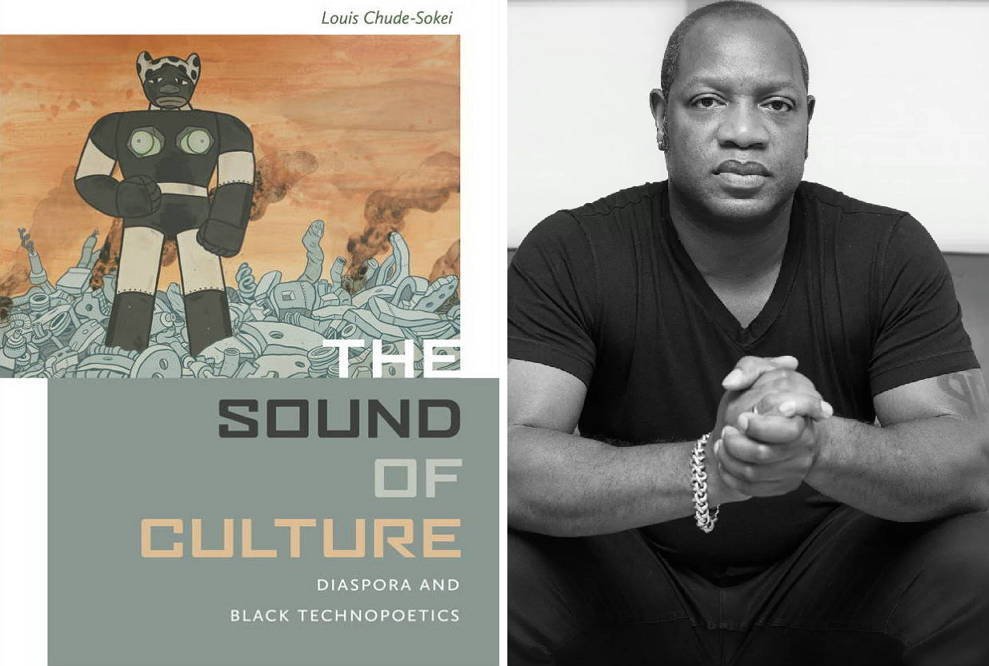
    In his new book, The Sound of Culture: Diaspora and Black Technopoetics, Louis Chude-Sokei samples freely from history, music, literature and science, conjuring new meanings from dead texts, to build an echo chamber where the discourses of race and technology collide. At a time when automation threatens jobs and pits humans against machine and Artificial Intelligence systems manage financial markets, Chude-Sokei’s arkeological excavations reverberate through the future-present. In this conversation, he joins Kodwo Eshun and Appau Junior Boakye-Yiadom on a journey into science fiction and Afrofuturism that engages the intimate relations between black peoples and technology within the wider imperial histories of industrialisation and slavery.

    “What then comes up for me in this conversation about the limits of the human is what constitutes the human, right? Because whenever you ask whether or not this is human or that is human, you’re actually asking “what is the human?” in the first place. Which is a question that we still don’t really know. The same thing when we talk about artificial intelligence. What artificial intelligence has taught us is that we don’t know what intelligence is. Whenever we encounter a machine, can it think? Does it have a soul? And then the question becomes: well, what is thinking? What is a soul? Are they human? Do they merely mimic us? Will they take over from us? Will they revolt? These same exact questions that were asked about slaves during slavery. This is not an accident. Things that seem accidental are not accidental at all. It’s a shared logic around a restrictive understanding of what constitutes the human. And that’s where blacks and robots and machines really come together – not just in a clever, theoretical formulation. It’s there in history. It’s why Robert Johnson wants to have sex with his phonograph.”

    Read more from an edited transcript in The Chronic: The Invention of Zimbabwe.

    [hr]


     The Chronic, “The Invention of Zimbabwe”, writes Zimbabwe beyond white fears and the Africa-South conundrum.

    The accompanying books magazine, XiBARUU TEERE YI (Chronic Books in Wolof) asks the urgent question: What can African Writers Learn from Cheikh Anta Diop?

    To purchase in print or as a PDF head to our online shop, or get copies from your nearest dealer.

    [button link=”http://www.chimurenga.co.za/chimurengashop” color=”red”]Buy the Chronic[/button][button link=”http://www.chimurenga.co.za/subscribe” color=”red”]Subscribe[/button]

  • Steal Back the Treasure

    Calls for restitution African artifacts from Western museums are mounting. Against this backdrop, Nigeria’s response to the British (Second World Black and African Festival of Arts and Culture) in pirating the head of Queen Idia to use it as a logo for Festac 77 , proposes another dissonant route that challenges the very idea of the work of art as unique object.

    Tam Fiofori gives the history “When in the run-up to FESTAC ’77 Nigeria asked Britain and the British Museum to return the exquisite carved ivory mask of Queen Idia which had been chosen as the symbol of the FESTAC ’77 logo, the British had the diplomatic nerve to suggest that the Queen Idia could be loaned to Nigeria for a sum of two million pounds sterling. Of course Nigeria rejected the ridiculous offer and, Oba Akenzua 11 – Patron of the Benin Bronze casters, Ivory, Wood carvers (and other) Guilds – asked the best of the skilled ivory carvers of Benin to produce a ‘photographic’ copy of the original carving and this was successfully used for FESTAC ’77.” (Forever Bronze, Modern Ghana, 2009)

    Meet the artist who pirated Queen Idia back in calving the Festac 77 mask below.

    Check out Akin Adesokan’s Festac 77 a faction that explores art piracy, the curse of Festac and its many restless gods and even suggests the festival was curated by Esu Elegba:

    Imagine,
    first,
    a priestess of Esu (Elegbara), the West African god of the crossroads and inspiration for the less tangible practice of hermeneutics. The woman, in her late sixties when the story begins, in August 1976, in a small village three hours by car north of Lagos, is also the mother of twins born in 1930. One of them was dead within months of birth, hence the obligatory recomposition of the spirit of the departed in ere-ibeji. The twin sculptures are polished to shiny black by original emulsion and decades of oiling and handling. Her profession of Esu does not confl ict with her attendance on the spirit of the twins, or even the fact that her children answer to Muslim names. Both are her life, fabric of the relative peace of early-to-mid-twentieth century western Nigeria, “with its modern constructions with one foot in the bush…the whole area with its infi nity of night lights that appear to illuminate the noise”, as seen through the eyes of Edouard the Antillean. The peace was relative because, in times past, when she was not yet a child, gunshots from the hundred-year wars were the heartbeats of life, its passions the periodic fi res of ostentatious destructions. Insensate times: the smell of burning ivory, the sound of blunderbuss, the undying certainty that what was sold down the river for a fl ask of rum or sachet of gunpowder could not, like the river, fl ow back. What was gone was gone; the law of eternal return did not apply. Her name is Elesu, she who professes Esu.”

    Soyinka proposed we simply steal them back:

    “Perhaps the single most significant event of that festival, however, was one that never did take place: this was the repatriation of the original of the symbol… [the] famous ivory mask from Benin, exquisitely carved and detailed, remained safely ensconced in the vast labyrinths of the British Museum in London. The mask was stolen property, and the aggrieved had a right to reclaim their property by any means. What I proposed instead was that a task force of specialists in such matters, including foreign mercenaries if necessary, be set up to bring back the treasure—and as many others as possible—in one swift, once-for-all-time, coordinated operation. Spiriting away the Benin mask for FESTAC—the 1977 Festival of Black and African Arts—in good time for the opening of the festival would have been much easier, cost much less, and redressed, albeit symbolically, an ancient wrong. I was quite ready to be part of the team. The potential consequences seemed trivial, considering the prize.” (Wole Soyinka, You Must Set Forth at Dawn: A Memoir, 2007)

    This has been this has been the basis for Nigerian cultural production since Festac – Onitsha, nollywood, Naija jams etc. Also read Uzor Maxim Uzoatu’s on the Onitsha Republic and Louis Chude-Sokei on how Nigeria invented the internet.

    More soon come! Watch this space for the FESTAC book and LP.

  • New Bush, Old Ghosts

    Cyber crime is a burgeoning business in West Africa, despite often primitive infrastructure, intermittent electricity supply and Western assumptions that Africans surely could not be capable of the third largest bank heist in history. Louis Chude-Sokei speaks out, graphically remixed by 3bute.


    vol16coverweb

    Louis Chude-Sokei‘s story can be read in full here and was originally a feature in Chimurenga Vol. 16: The Chimurenga Chronic (available here).

    Set in the week 18-24 May 2008, the Chronic, imagines the newspaper as a producer of time – a time-machine – which travels backwards and forwards, to place these events within a broader context and thereby to challenge the logic of emergencies and immediate needs that characterise contemporary African media.

    [button link=”http://www.chimurenga.co.za/product-category/shop-items/the-chronic” color=”red”]Buy the Chronic[/button]

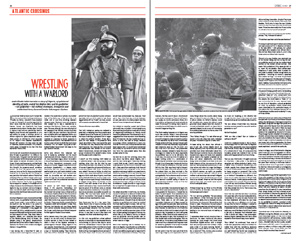
  • Wrestling With A Warlord

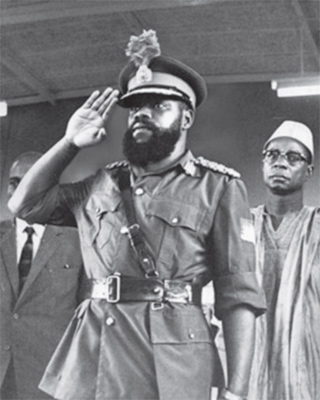
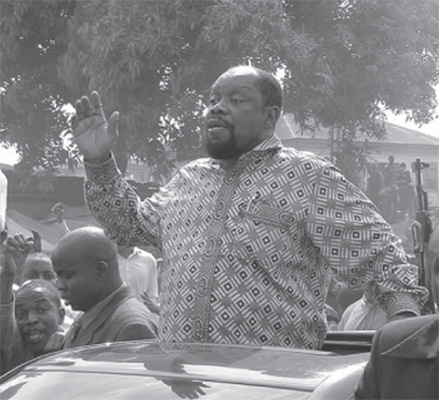
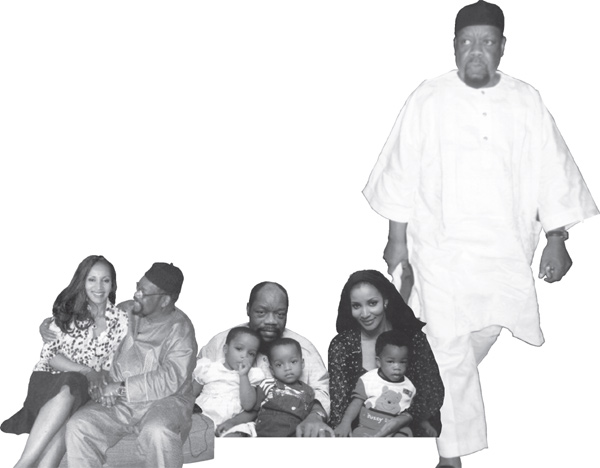
    Louis Chude-Sokei narrates a story of Nigeria, of splintered identity, of exile, and of the Biafran War and its godfather – his godfather – the military strategist, strongman and celebrated hero, General Emeka Odumegwu Ojukwu


    wwl    wwl2


    I remember thinking how much I looked like him. So much so that, had I been told he was really my father, I wouldn’t have doubted it even as I denied it. It was the beard. At the time I wore mine like one of my Rastafarian heroes, though my dreadlocks had been unceremoniously shorn the day after I landed in Lagos. It was only my second trip back to Nigeria since the war and apparently no one was willing to accept a Jamaican symbol of African origins. For Igbos dreadlocks were isi dada, grown on children for ritual purposes or for reasons now deemed superstitious, though still common. Or they were the sign of madness, dreams unshared. Only America made sense. It needed to be clear that that was what I had to offer.

    On this trip all I could think about was the last time I’d seen my godfather – in 1985, on my first trip back. The great man had summoned me. It was also his first time back, because he’d been exiled for almost 15 years in the Ivory Coast. I’d returned because my mother finally felt comfortable with me travelling to Nigeria.

    She thought his presence would somehow protect me from the government or even more so, from my family. Many people hadn’t forgiven her for escaping with me during the war, just after the hesitant nation of Biafra had collapsed. After my father’s death we’d made it out of the country on one of the last airlifts to Gabon. Rumour had it that my godfather had arranged our escape. To the elders of the village, however, it was kidnapping. She had no rights to me, as a woman and as a foreigner. Upon my father’s death she’d been forced to become what she’d been before she’d married him: a Jamaican.

    Arriving in Nigeria to rapturous crowds and high military alert, my godfather had been placed under house arrest. It was unlikely he could do much for me. We drove in my uncle the Barrister’s well-worn Peugeot 504, “Nigeria’s Prestige Car”. I remember a long, jagged red dirt road that led to a wide house in a narrow compound filled with family, fans, well-wishers and stern-eyed old men. They were there to support, defend and celebrate the return of the Ikemba (Strong Man) of Nnewi, Eze Nd’Igbo (King of the Igbos), Dikedioramma (beloved hero), first Biafran head of state, the General, the Warlord, Dim Emeka Odumegwu Ojukwu – my godfather.

    I was staring into a face that I’d seen on numerous book and magazine covers, not to mention the avalanche of photos my mother kept of the Biafra war, of her time lost in its midst and of our time shuttling between refugee camps. Perhaps it was just arrogance that caused me to see a resemblance to someone that famous. There was, certainly, awe. This was, after all, the man who had led the secession that officially started the Biafra war in 1967, the year I was born. He told me it was my father who had suggested Biafra as a name for the Igbo nation that they had rapidly invented in response to brutal pogroms in Nigeria’s Muslim north. That secession had led to a four-year civil war in which the much more numerous and far better equipped Britishbacked Federal Government laid siege to the Igbo lands of the East.

    Biafra was Africa’s first televised war and it made my godfather and his beard internationally famous. People in the US and UK may have been vague about its location or its political details, but there was one thing few in the international community could escape as the war dragged towards its brutal conclusion: kwashiorkor – a disease made famous by that war, where starving bodies swelled past irony and heads doubled in size. Images of such children were everywhere, taken by journalists and aid workers who broke through the blockade established by a government that had proclaimed starvation a legitimate tactic of war.

    I’d grown up with these images, also those of the pogroms, beheadings and disembowelments and corpse-littered villages. My mother had carried many of them with us in the hope of getting them to the international press. Like many of the pictures from Vietnam, some became iconic. Celebrities and activists used them to drum up support and attention for Biafra. There were charity concerts like the “Operation Airlift Biafra Benefit” in New York, featuring Jimi Hendrix and Joan Baez. Beatle John Lennon famously refused his MBE from the Queen, partly because of Britain’s support for the Nigerian Federal Government.

    Biafra became more than just a fashionable cause in an era with many to choose from. A white woman in Paris burned herself to death in front of the Nigerian embassy in protest against the war being waged on the Igbo people. Bruce Mayrock, a US student at Columbia University, immolated himself, with a sign on his body reading “Stop Genocide, Save Nine Million Biafrans.” Things went so global that then US president Lyndon Johnson reputedly told one of his aides to “get those nigger babies off my TV set”. As many as two million people are estimated to have died. This was the man responsible.

    That he’d insisted on seeing me mattered a great deal, considering how many people were clustered around the house and compound in the hope of catching a glimpse of him or eager to obtain his political sanction. Those sterneyed old men seated in his presence were clearly ex-soldiers. They now wore the garb of old men, not only because that was what they’d become but because the compound was staffed also with soldiers of the current Federal Government. Armed and tense, both groups monitored the General’s every move and the people who visited him.

    It wasn’t our first meeting. He’d visited us in California when I was too young to know anything other than the fact that he was famous and had been very close to my father. Of course I’d seen the pictures and books, our house was littered with them. Friends had even asked if he was my father, to which my mother never responded well. But I hadn’t yet begun to think much about Nigeria, much less Biafra. We’d left Biafra for Jamaica under cover of night and journeyed through a kaleidoscope of refugee camps. When we landed on the island it was with stories of an Africa they weren’t yet ready to hear. Jamaica had finally become proud of its African roots, so stories of genocide were unwelcome. It was best to become as Jamaican as possible as quickly as possible. This may have been easier for me than for my mother. I had as yet no identity, whereas she had developed too many.

    Then there was the US a few years later.

    There I lived in fear of anyone noticing cracks in my mask. I’d learned that the one thing that guaranteed ostracism from the African- American world was to be identified as an African. It was best to sound like them and disappear into their understanding of skin. On that visit my godfather arrived without security or entourage and was dressed like any uncle arriving to spend a few days in sunny California. Sandals even. I had no idea that he was in exile, and would return to the Ivory Coast after leaving this small bungalow in a largely black working class neighbourhood just east of the Pacific Ocean. Had I known, the contrast would have embarrassed me, because I had yet to learn that that very contrast between an epic past and a mundane present was the story of many immigrants and refugees. He insisted on spending a great deal of time alone with me, and what I remembered more than anything was that he moved with the kind of elegant self-confidence my friends would have called effeminate. This stayed with me. It suggested that fame was even more liberating than I’d dreamed. He also taught me how to throw a knife. We used an empty shoebox as a target. I think I wanted him to marry my mother. For him to do so would somehow have been appropriate. It would have maintained the sanctity of my father’s memory and freed me from the ever-present sense that she existed solely for me.

    He told me to ask him anything, about the war, about my father, about Nigeria. Did I want to learn some Igbo? There was nothing I could think to ask. I hadn’t even begun to make sense of my childhood in Jamaica. I was still a few years from exploring back beyond the island and had only gotten as far as the symbols most recognisable to my peers here in California, which, to be honest, were few and are too embarrassing to recount. It wasn’t New York or London or D.C., where black Americans were familiar with other types of blacks. Black Americans had been calling us African Booty Scratchers or Jungle Bunnies or Ooga Boogas for so long that I thought it best not to provide them with ammunition.

    He asked about life in California, my friends, my world. Perhaps in an attempt to feel worthy of the epic past and the violence that came with it, I told him about the street gangs in our neighbourhood. I thought these stories would impress my godfather, and when he nodded his head silently, clearly moved, I felt as if my proximity to this violence made me worthy of my past. I knew he’d led an army and fought a war and that my father was also a hero of that war. I’d been seeing the images of that war my whole life, of my father’s training in Britain and my godfather standing poised next to men whom I’d next encounter in history books when I went to college.

    More than anything else he wanted me to return to Nigeria. I was the first son of the first son and the country needed me more than the US did. I was still young enough to respond with a desire for adventure and fantasy. The long lost son, the heir, would return. Blood would make deeds unnecessary. There would have to be a quest, no doubt a princess or three. And it was Africa, so there would most certainly be need. The irony of him telling me to return to a country he couldn’t return to didn’t occur to me until I began writing this.

    That first meeting between us in Nigeria was much less private. When it was announced who I was – or who my father was – the people around him began to stare at me with a portion of the reverence my father had commanded. The ex-soldiers all froze, leaning forward with interest and surprise. Eventually my godfather sent everyone away so that he and I and my uncle could be alone. The government soldiers, however, refused to leave the room and began to cluster by the door. Apparently my godfather was not to be left alone. Not a tall man, he stood up from the settee and began barking orders in a combination of Oxford English and what I assumed was Hausa, though it could have been Yoruba. At the time I couldn’t tell the difference. The men quickly fell into line. Their eyes faced rigidly forward, but with that slight military tilt upwards. When he ordered them out they marched in file, and their leader closed the door behind them apologetically. That a prisoner could command his guards was a staggering notion, as was what seemed a sudden easing of tension as the roles were reversed. It was as if he had done them a favour.

    Six or so years later, I was summoned again. My newly shorn scalp was sensitive to the heat, but I was grateful for the haircut. I looked like my father, he said happily. That wwl3resemblance was the only gift I could give him. We met at one of his remaining properties, on the posh Victoria Island. There were no red dirt roads, just incomplete highways and bridges ravaged by age. He’d spent the years after exile reclaiming all that had been stripped from him during and after the war. He was the son of Africa’s first millionaire and had much to regain. As with the previous visit, he greeted my uncle with great affection. After a brief kola nut ceremony and beer, they spoke in Igbo, first incantatory and then broken with occasional laughter. Then my uncle left us. There were no ex-soldiers about. Later one of my uncles said that the government so feared my godfather that he was forbidden to associate with soldiers or ex-soldiers.

    At that point in my life I was sure that I’d be returning to Nigeria, and I expected to ask him many things about the country, about being Igbo, and about his plans for Nigeria. This was a culture where my father’s memory could still translate into power. My father’s name grounded me so deeply here that my lack of cultural authenticity wasn’t an issue. But it seemed indecent to ask a man still recovering from political exile about my future, even if he was my godfather.


    wwl5

    This is an excerpt from  Louis Chude-Sokei’s epic biographical narrative, published in the December quarterly edition of the Chronic.

    To read the article in full, get a copy in our online shop (in print or as a PDF) or visit your nearest stockists.

    Chude-Sokei is a Jamaican-born writer and critic based in the US. His book The Last Darky: Bert Williams, Black-on-Black Minstrelsy, and the African Diaspora was a finalist for the 2005 Hurston/Wright Legacy Award

  • New Bushs Old Ghosts

    Cyber crime is a burgeoning business in West Africa, despite often primitive infrastructure, intermittent electricity supply and Western assumptions that Africans surely could not be capable of the third largest bank heist in history. Louis Chude-Sokei tells otherwise.

    Despite being accused of mangling Africa’s past and embarrassing its present, author Amos Tutuola was really after the future, something his critics never understood. Prophesy is a dirty business and the future he saw for Africa – assuming you read The Palm Wine Drinkard and My Life in the Bush of Ghosts with forward-looking and backward-bending eyes – was simply not as pretty as that old mania for freedom insisted.

    For example, there was nothing quaintly folkloric about the description toward the end of The Palm-Wine Drinkard of marching armies of dead children, terrorising villages and towns just like the child soldiers who’ve been suckling at the guts of the continent for the past decade. And they are always already dead. In Tutuola, nothing was more terrifying than this inevitability.

    But it’s in My Life in the Bush of Ghosts that you get the clearest mangling of youth and the possible. The book is full of references to Western technology – all indistinguishable from the “juju” that suffuses his work. As Arthur C. Clarke postulated, “any sufficiently advanced technology is indistinguishable from magic”, which is to say that magic is merely any sufficiently advanced technology.

    Take the “Television-Handed Ghostess”, whose palms are screens through which our lost hero sees his home, family and friends. It is through those screens that he teleports home after decades lost in a bush that upon careful reflection is very similar to the internet. It is structured by de-centered, recursive pathways, full of strange sudden creatures and is rich with endless possibilities for freedom and terror, valleys of gain and loss.

    Take also the “Invisible Missive Magnetic Juju”. Tutuola describes it as a communication that can bring someone home no matter the distance, even against his or her will. Now past the 1990s cusp of the Nigerian internet crime industry, what matters is that for this juju to work (and it doesn’t), one has to pay up front. It is essentially a 419, named from the Nigerian criminal code, also known as “advance fee fraud”.

    It’s hard to shake these scenes from your head as you walk through those areas in Nigeria called “computer village” – from Alaba in Lagos to the one in Onitsha, by the River Niger. Through clouds of red dust are signs: “Computer Repair”, “Speedy Programming” and “Internet Café”. These are indeed magical places, made of battered wood and rusted zinc. It’s where the detritus of Western and Eastern digitisation either goes to pile up in jagged cathode ray mountains and die, or awaits repurposing in wiry bundles and circuit board batches spread across acres of e-waste.

    My Life in the Bush of Ghosts cover

    These computers and components have been donated by Western charities and NGOs. Many were brought from Ghana or South Africa while a steady stream arrived from China even before that country began its obsessive courting of the continent. But the vast majority of these machines have been brought in by enterprising Nigerians, who since the late 1980s have known that what would mark this generation more than blight, violence or corruption was a hunger for web-based connectivity. With almost no formal education, many would master the essentials of computing in this bush of potential ghostware.

    The hunger for information technology wasn’t generated simply by the dubious pleasures of globalisation on satellite TV. It was generated by decades of forced national myopia due to a series of military dictators, who appeared just as the overdeveloped world was going digital. The government’s intense denial of information during that period had much to do with the hunger for global connectivity and the lust for economic growth that has characterised these last 30 years of Nigerian cultural life. So if Bangalore can be credibly called the “Silicon Valley” of India, “computer village” demands some similar sobriquet because its place in the world and history of the internet is equally assured. While India has become a primary site of internet outsourcing, Nigeria has become home to “invisible missives” that might have emerged following oil wealth during the era of the dictators, but arrived at everyone’s doorstep with computers. That they began as hand-written letters, travelled globally with the introduction of fax machines and the internet, and are now disseminating wildly with cellphones, shows their tandem evolution with communications technology in West Africa.

    What these scams really are is the public face of West Africa’s intimacy with digital technology and of Nigeria’s refusal to wait passively for justice from their political system or global charity. Few outside of Nigeria, however, take them seriously and are stunned to learn that so many people in so many countries fall for them. Official statistics suggest they bilk the United States of billions of dollars per annum and even more in the UK. Now that they’ve set their sights on China and India after decades assaulting Singapore, Australia and Ukraine, there is more for them to gain.

    With this year’s global economic downturn promising to affect not only foreign aid but also the economy-sustaining remittances sent home by immigrants, we should brace ourselves. There will be more of those comical, strangely earnest emails clogging our inboxes and promising us intimacy with a world that might be as excitingly unstable and magically profitable as it seems.

    The strangest thing about these scams is this: they have become such a part of our lives and the lives of banks, lawmakers, the FBI, Interpol, Scotland Yard, The Royal Canadian Mounted Police and innumerable citizens without anyone balking at the very idea of cyber-crime from a country where much of the population is without regular electricity, running water, access to computer technology, decent transport and road infrastructure, and survives on less than one US dollar a day. Even with optimum access to an internet café in Nigeria it can take hours to download a single song from iTunes or days to retrieve a simple document.

    Yet Nigerian scammers are perfecting the art and science of website construction and pulled off the third-largest bank theft in history: Banco Noroeste in Brazil in 1998. They have robbed Merrill Lynch, impersonated governments and hustled government officials, and done irreparable damage to the reputation of Nigeria’s legitimate business sector.

    Though belied by the ramshackle modesty of internet cafés, staggering losses have been identified in more than 38 countries. This should make us rethink commonly held assumptions about the “digital divide”, as well as stereotypes of passive Africans whose suffering is their only virtue. But this is not unprecedented in the black world. A prophetic example is an island like Jamaica, which on the verge of its political independence produced a tech-savvy and machine-obsessed shantytown musical culture that went on to irrevocably transform global sound production. Reggae too emerged in, around and, arguably, due in part to crime.

    It’s no accident that the scammers – locally called “Yahoo Boys” after their beloved ISP, one of the first to be freely available in Nigeria – carry themselves with a trickster swagger. Much of their style and taste in music is indebted to reggae rude boys and hip-hop ‘hustlas’. Because their activities are tacitly supported by many of the disenfranchised and because they are connected to forces in the political status quo, they walk aware of their position as quasi-folk heroes.

    One wonders if the casual acceptance of their scams and the ease with which they have been turned into humour might have something to do with how the world generally feels about blacks and Africans. It is possibly because the scammers and their fake websites, counterfeit documents and intricate global networks come from a place rarely linked to sophisticated technology or this level of guile.

    Many letters actually play on this combination of innocence and venality. They are written in a prose not too far from Tutuola’s, with its brash, hyperbolic naiveté, its wild schemes and seemingly accidental poetry and its clear hearkening back to those wide-eyed Onitsha Market Pamphlets that are the root of modern Nigerian fiction. Such language easily reduces one’s guard. After all, could you really be duped by someone with such atrocious grammar?

    It’s a classic con, really, the first rule of which is that you convince the victim that you the conman are an utter idiot. The second is to engage the victim in a conspiracy in which both of you are on the edges of guilt, if not in the midst of full culpability. That conspiratorial intimacy keeps them afloat over time and space. It is also responsible for one of the most curious psychological aspects of these scams. After investing x amount of money, it becomes easier and easier to invest more. Desperation mutates into an aggressive form of trust. Victims begin to flagrantly display their vulnerability, sending money blindly into the void.

    This conspiratorial tone is crucial to the ethics of the scammers. Ethics, because if the success of the 419s depend a great deal on how the developed world sees Africa and Africans, so are they an index of how many Africans see the over-developed world. Yahoo Boys – or Sakawa boys in Ghana, who have turned explicitly to juju to guarantee their scams – certainly know they are breaking the law.

    However, they are not convinced what they are doing is a crime, especially if the so-called victim willingly participates in a clearly suspicious scenario. To respond is to comply, blinded by your own greed. The money, after all, comes in sums far too large to be legal and the transaction is in some trans-national grey area, hence the need for haste and secrecy. This, however, is only true for the “advance fee” scams, but is the structure to which the Yahoo Boys almost all refer to for justification.

    To speak to them and move through the culture that has sprung up around them in Lagos – beer parlours and night clubs on Allen Avenue, Chinese restaurants in the suburb of Ikeja or on Victoria Island where real money displays itself – is to hear talk largely of morality. In some ways this is not surprising. Nigeria is a barely secular country and the Yahoo Boys are Christians mostly, since it is in the south and south west that these crimes and this culture are largely clustered.

    The Muslim north has always been cautious of and resistant to Western education and technology, which is also why it is taken for granted that 419 must have been developed by Igbos. Igbos were among the first to embrace Christianity and Western education in Nigeria and are most often victims of the genocidal fury of the North. Since the Nigerian Civil War, in which that fury was most notoriously expressed, ended in 1969, they have felt kept from their share of the country’s wealth and political power.

    Yet the obsession with ethics is also not surprising because to speak of morality in the context of Africa, Jamaica, the West and crime, is to speak of colonial history. However disingenuous their arguments might seem, most Yahoo Boys are clear about their relationship to continuing forms of economic and political domination. Or, at least, they are clear about their mastery of this language of guilt and innocence, victimisation and responsibility.

    So to speak of 419 is to address the fragile and dubious architecture of foreign aid, debt and charity that undergirds the West’s continuing under-development of the African continent. It is also to address the complex and often inadequate ways that many on the continent respond to their predicaments. But perhaps in this muddle of ethics and reparations, history and compensations, there remains a hint of that strict moral code that papa [Chinua] Achebe famously identified in Tutuola’s writing.

    After all, despite their intimacy with computers and the internet and despite new, ever-more sophisticated generations being spawned in “computer village,” no Yahoo Boy has ever directly hacked a system. Well, none so far.


    vol16coverweb

    Louis Chude-Sokei‘s story was originally a feature in Chimurenga Vol. 16: The Chimurenga Chronic (available in our online store). A comic version by 3bute is digitally viewable here.

    Set in the week 18-24 May 2008, the Chronic, imagines the newspaper as a producer of time – a time-machine – which travels backwards and forwards, to place these events within a broader context and thereby to challenge the logic of emergencies and immediate needs that characterise contemporary African media.

    [button link=”http://www.chimurenga.co.za/product-category/shop-items/the-chronic” color=”red”]Buy the Chronic[/button]