CHRONIC BOOKS
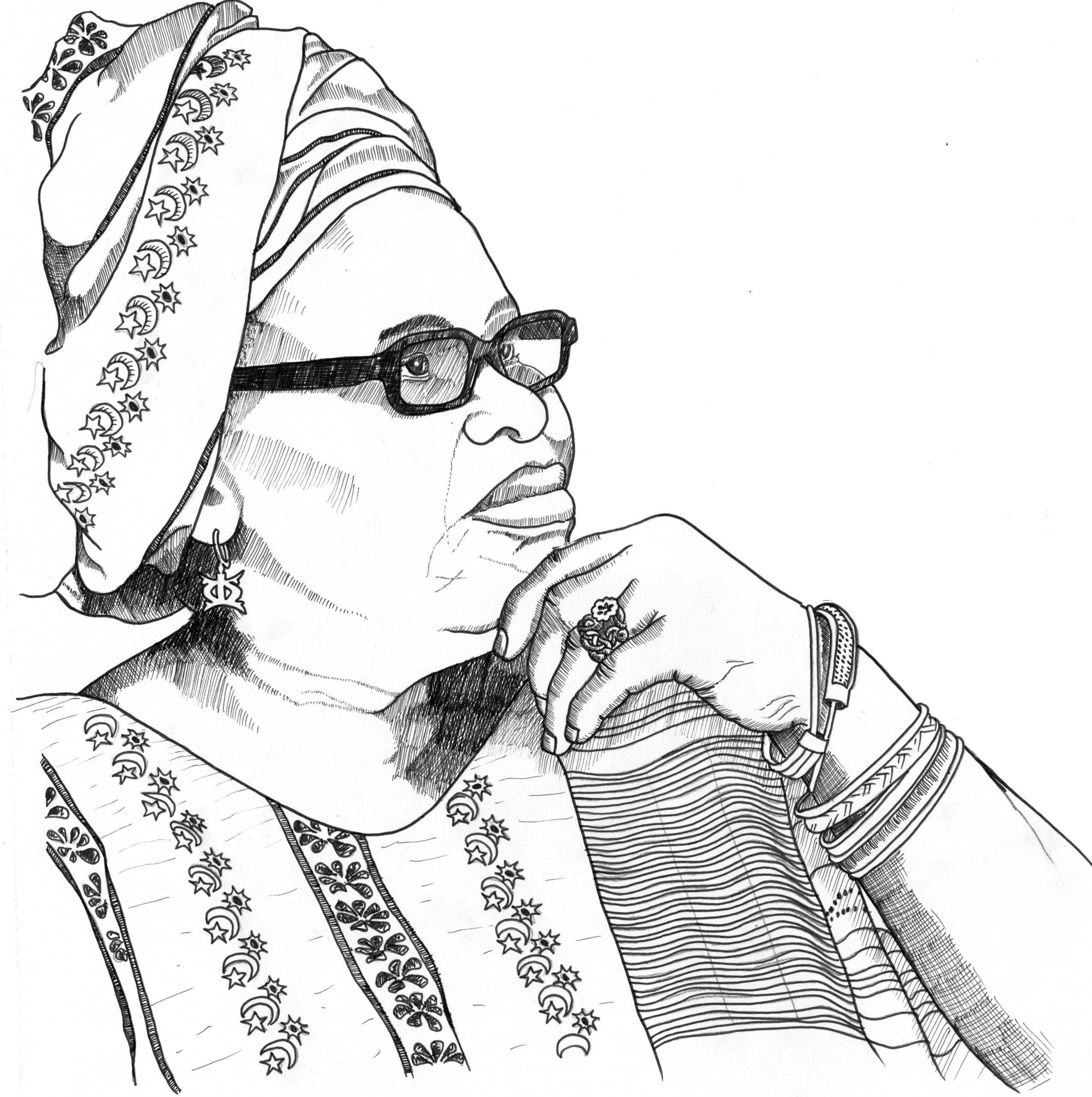
The writer Ama Ata Aidoo speaks to Madhu H. Kaza about the imbalances inherent in the art of writing, the commonalities of struggle among African and diaspora women writers, and her work and friendship with the indomitable poet and cultural worker Jayne Cortez. Illustration by Graeme Arendse.
Madhu H. Kaza: You started the Organisation of Women Writers of Africa (OWWA) with American poet Jayne Cortez, who died last
year. You first met Cortez in Nigeria. What was the context?
Ama Ata Aidoo: It was during FESTAC 77, a festival of arts and culture for all peoples of African descent held in Lagos in 1977. We just started talking to one another. As her husband Mel Edwards always reminded me, we were in a queue for food and we just got talking. It was just a chance meeting. But we agreed to meet later and have a meal together.
Jayne was always such a dynamic, charismatic kind of person. She had an electric and electrifying personality. She was absolutely visionary, a real cultural worker. Sometimes we use these words, but every now and then you discover that that’s exactly what these words were meant to describe. She was fearless, [with] a lot of gumption, in your face. But also really fun.
We kept in touch. Not very intensely. She was one of these colleagues whom you meet when you meet. But every time we met it was like we’d just been together and talking the previous day. We fell easily into discussing issues that were important for us. She used to come to Africa quite often. Every now and then I would land in the US and we would get in touch. She and Mel lived in a flat in Manhattan for a long, and they would ask me to come over, or sometimes we’d meet in a café. During one of our meetings we thought maybe we should start an organisation, some kind of support system for women writers of African descent. So that’s what we did. In 1991.
There is something quite empowering for those of us who are residents of the mother continent when we meet our people of the diaspora who are also interested in the connections. Meeting someone like Jayne always gave me a sense of wholeness. When I visited her in New York she would give me African cloth as a gift. Can you imagine? A piece of woven Kente, or some other woven cloth from some other African country and it was like affirming me in the value of what I already have. The thing is, of course, I have Kente or I have other woven cloth but when it came from her, it was her saying here is something precious, something I value and it happens to be
African and I want to share it with you.
And, of course, as writers it was interesting and affirming for me to meet women of the African diaspora and encounter their writing and to discover that their problems are not so different from ours. When their ancestors were taken away, our ancestors who remained on the continent were also enslaved. You can call colonialism some form of slavery. In the long run, our destinies were brutal and ran into the same hole. The passages of no return were in dungeons in the slave castles, but those who didn’t go through a passage of no return didn’t end up better off. The level of brutality, the intensity of it, was definitely different, but frankly we were enslaved. It is one of the harder truths that we don’t want to deal with. But that’s what happened to our ancestors.
MHK: The first two Yari Yari conferences were held in New York. This year you hosted the third one in Accra and it was Jayne, I believe, who was insistent on it being in Africa.
AAA: It’s amazing how these things happen. I was teaching at Brown University. Chinua Achebe – may he, too, rest in peace – was a professor at Brown and hosted the annual Achebe Colloquium on Africa. Jayne was at those conferences every year and the second year, we thought we would go to some popular restaurant in a fancy place in downtown Boston that everyone knew. Over the course of the meal the idea of having the conference was born.
“We’re going to have it in Africa, Ama.” It was like da da da da da! It was all done! That was Jayne. Her only concern was that younger African women and women of African descent might not want to carry forward with Yari Yari. I said, that would be a pity, but that we still have to go on. And it was absolutely wonderful. Wonderful. A confirmation that Yari Yari endures. Now, with Jayne gone and me here I don’t want to talk big – we don’t know what will happen.
MHK: What is the situation of women writers here? What are the needs?
AAA: To begin with, all writers have always needed two things at least. The space for the work and the time. Space and time have never been free, anywhere, anytime. I can go back to the early 20th century, to someone like Virginia Woolf who said a woman writer needs a room of her own and 500 pounds. It would be a lot more today. Virginia Woolf belonged to the chi-chi, fa-fa upper middle class in Britain, so if she was challenged, then how about us in Africa? Writing in the language of our conquerors, we are already challenged. And then look at the state of the continent, the developmental challenges. No one thinks of writers as needy. I was talking to a gentleman who works with one of these big international organisations. One day I asked him if he could help us with Mbasem, the organisation I founded to support woman writers in Ghana and the rest of Africa, because we were severely challenged for funding. And he said, I wish we could, but we don’t consider writers to be needy. We are interested in helping really, really poor people with their health, with potable water and so on. That was that. It was a clear slap in the face, like asking me, “How dare you? You are already a known, published writer, a university teacher and how dare you come and expect me to siphon any of the funds we use for really needy people for your enterprise.” So then the idea is you have to be well-endowed financially to write.
MHK: I remember a story of yours about a teacher who is conflicted because she wants to be a writer, but she needs to make a living.
AAA: No. She is a writer, but compelled to make a living. She tried teaching, then she tried trading. She went to seek guidance from her mother and her mother said, “What in the end do you want to do?”
The international NGOs and funding agencies can have their criteria; I never question them, because I think in a way we should be able to take care of ourselves. We should not to be running to them. When they say, we are not about you but about those relatives of yours who are poorer than you, I don’t argue. But to come back to your initial question, the point is writers have always needed time and space to write. And things have been getting harder for writers in general, but particularly for women writers because in African societies, as in other societies, women are expected to overlook their own needs and take care of everybody else. Not only is there no sympathy on class lines, but in terms of gender, when it comes to women, society doesn’t expect
you to even be concerned with your needs as a writer.
MHK: At the same time, every once in a while, the West gets fascinated with Africa or other parts of the world, like India, in a particular, sometimes in a narrow way. The selection of a few representative artists or writers for Western consumption seems as curated now as before. I’m curious about the relationship between writing that circulates globally and the local literary scene.
AAA: It has little to do with what’s happening here. But here’s where I’m coming from. Writers don’t receive any attention, anyway. Even when you are a white, male writer – right there at the top. Somebody, an agent, an editor has to get their “aha!” moment vis-à-vis a manuscript, and then they decide to push that book. Luckily for the reading world, most of those books are worth the push. But that’s how it works, they decide this one, that one, that one, or that one. Even with male white writers. And with female white writers it’s the same. When it comes to black writers it’s the same. Now at the bottom of all that are African women writers. There was a white male academic who was working on African literature and in 1989 he wrote a scholarly book on “the contemporary West African novel” and didn’t mention a single woman writer. By 1989, Mariama Bâ’s So Long a Letter had been out for about nine years. How could anyone discuss the novel in West Africa without talking about Mariama Bâ? When I challenged him he said, “Well Ama, frankly, I thought I was being radical enough discussing African writing at all, without expecting to deal with books written by African women.” I could mention the person’s name but I won’t, because it just wouldn’t be nice.
So I don’t mind when someone is picked by the West. At least they’ve been picked. Chimamanda, for instance, has been picked and she’s good. So I’m very happy for her. And right now luckily another writer, a young Ghanaian woman Taiye Selasi, who wrote Ghana Must Go, has been picked. She is getting a lot of attention. It took a lot for that to happen. All I have ever asked of agents and publishers is that they see in my work the opportunity to make money for themselves so that my books can get around and maybe they can make a little money for me. That never happened, but I’m very happy it’s happening for other people.
MHK: A lot of your work deals with relationships between generations, especially between generations of women. Mothers and daughters, for instance. The anthology you edited a few years ago, African Love Stories, also took this approach by placing work by established writers and younger writers in conversation.
AAA: I’ll be honest, in terms of the selection, the publisher’s input was a lot more crucial than you’d think. Ayebia Clarke was absolutely instrumental in the selection of the writers and she doesn’t get credit. I think it’s a wonderful book. I enjoyed my job as an editor. I love the stories. It was precisely the fact that we wanted to give a view, an idea of African literature, of fiction by women that is robust and links the generations. What is painful sometimes is that the foreign media and editors don’t consider older writers. There is some notion about young African writers that foreign editors find fascinating. There is also an idea that the real writing is being done out there – in London, New York or Paris. That is completely unfortunate. Some young writers buy into that and I think that’s terrible. The idea that the more authentic African writing is happening outside of Africa – because of some global notion that they are writing for the world – is ridiculous. Frankly, when I started writing I wasn’t even aware of an audience. So any notion of that audience that I may have now is defined in retrospect. Now, I write for any Ghanaian who can read my work in English, any African, any person of African descent. Then for the world. It’s easy for me to say because now I’ve thought about it. But I didn’t start out that way.
MHK: Did you have a notion of yourself as a feminist writer when you started?
AAA: No, no. Me as a kind of ideological being, feminist, pan Africanist, socialist, I dare say – they all came later. Right from the beginning my writing may have exhibited some form of commitment, but it wasn’t anything that I dealt with to begin with.
MHK: Even though you’ve articulated an interest in writing for an audience that begins first with Ghanaians and then expands outward, your writing has always been worldly. For instance, in your first published work, Dilemma of a Ghost there’s an examination of the relationship between an African-American woman and the Ghanaian family she marries into. Our Sister Killjoy is not just about a young Ghanaian woman in England, you talk about Nigeria, you mention South Asia and Indonesia, there’s a part about Germany…
AAA: A Filipino man said to me, “Your book is one of the few I’ve read that’s from outside the Philippines that makes any mentions of us.” My awareness of the world comes from my parents, who were not even literate. I find it completely amazing, myself. My father and mother, in their separate ways, were aware of the world. They were rural Africans and yet they were very aware of the world and in their way they thought it was all right for the rest of the world to exist and to have impact on us beyond the terms of us being colonised. There was this sense that there’s a big world out there. This was reinforced by the very special way that my school dealt with us as growing young minds. Can you imagine, one of our English teachers decided when she was 70 years old that she would learn Russian. In Ghana. With teachers like that you were always aware of the world out there.
I don’t mean to cast any aspersions on the way that people negotiate their exiles, but frankly, some of the most insular, narrow-minded proto-nationalists are migrants. Their friends are from the mother country, they insist on speaking their mother tongue at every opportunity, they don’t want to meet other people. You can live in New York, London, Paris or Africa and be as narrow-minded as they come. Being in a cosmopolitan place is no guarantee of your outlook.
MHK: I have an aesthetic question for you. The first book of yours that I read many years ago was Our Sister Killjoy and it was not the conventional novel that I had expected. I was surprised by the experimentation. There isn’t a lot of plot. But there’s a lot of voice. There are pages that read like poems. There’s the letter. And there’s so much space in that novel, space on the page, space for the reader to fill in. Could you speak a little bit about your models, who were you influenced by in terms of that experimentation?
AAA: No. I have to confess that I had no models. I had to figure out that life’s narrative isn’t a straightforward linear piece of prose. It is sometimes drama, sometimes poetry. I was just doing what I figured life was about. When telling the story, if my imagination went to poetry, I wrote poetry. When it sounded so dramatic that there was no way I could handle it except with clear, forward dialogue, that’s what I did. I had no models for that one. I’ve always been amused when they describe Our Sister Killjoy as an experimental novel; I definitely wasn’t aware that I was doing an experimental novel. Even now, my notion of an experimental novel is more something like Joyce’s Ulysses. But then I don’t know if anyone consulted Joyce about writing an “experimental novel”. I don’t think it works like that. You write and it comes out odd.
MKH: So much of your work is about love. In the introduction to African Love Stories you write that people have thought of love in African writing as being subsumed under politics. But to turn that idea around, this needn’t be a problem. In your work, love is complex. It’s part of a big web of experience and there are many different kinds of love. Even when someone is being harsh there’s often love there.
AAA: You’ve read me correctly. Love is like life itself. Nothing is a straightforward narrative; love is not a linear principle, it has all sorts of branches. That’s how I see it. That’s how I try to portray it. You’ve got me thinking about Changes, where there is romance between Esi and the man Ali Kondey. And then there is the mother love, and the fact that even within mother love there are different kinds, because Esi’s relationship to her daughter is not like her relationship with her mother or her mother’s relationship to Esi’s grandmother. There are the love affairs. There’s marriage. And there’s the love between the two women, the relationship between Esi and her friend Opokuya, which is a different thing altogether. That’s how I see it.
MHK: Returning to the recent Yari Yari conference, Angela Davis was the plenary speaker. She spoke about how important African liberation movements and pan Africanism were to her as part of the Black Freedom movement in the US. I know that she was an icon here. You mentioned that you had her picture up in your courtyard for many years when you were younger, and you said that this was your first time meeting her. What did she represent to you back then when you had that portrait of her on your wall?
AAA: Someone like Angela Davis is like a world of her own. There was never anyone like her in the way she articulated our grief, our sense of outrage at the powers that be, and so on. Luckily some of us came upon her work when she was young and when she was going through her troubles with the US government and the prison system. I don’t know who gave me the picture of her, but I know I put it up because I found in her such a source of inspiration. Zoom to today: what has been so fantastic, meeting her, literally 40 years after I first put her portrait up in my courtyard, is how very little she has changed in terms of her clarity, her enthusiasm, her boldness. It’s incredible, Angela Davis has been talking in Accra in a way that people don’t talk anymore in the United States about the United States, about the people who have power in the world, about the poor and the disenfranchised. That has been so incredible. Sometimes you hear about somebody who was an icon when you were a kid and you meet them and it’s like “Oh, really?” They have become decadent or lost their mojo one way or the other. Angela has not lost her mojo. I’m so happy to be able to claim some small responsibility in getting her here.
Many of us so-called older activists are feeling that the train has already gone and all we have to do is wait for history and our children’s children to judge us and tell us we did not do enough. Angela puts everything in perspective. She points out that we have not had the big victory, but incredibly glorious moments. That’s what we should focus on, to move forward even in our advanced age, so that younger people can find some inspiration. At one of the talks she gave here, there were children in the audience. One of them, a 10- or 11-year- old girl, had the courage to ask Angela Davis a question. She asked how to go forward and get involved in activism – she didn’t use those words, but she asked Angela for advice. And Angela said something like, “Your instincts are all you need. We can overburden you with the totality of our experience.” She noted that the young have the freedom to be uncautious. Me, I usually advise people to go slow, be careful.

This story, and others, features in Chronic Books, the review of books supplement to the The Chronic: Atlantic Crossings (December 2013), This edition offers forays into interlaced subjects of power, resistance, protest, mobilisation, mobility and belonging.
To purchase in print or as a PDF, head to our online shop.
This article and other work by Chimurenga are produced through the kind support of our readers. Please visit our donation page to support our work.